
|
You entered: orbit
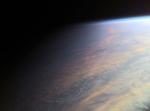 Earth at Twilight
24.04.2003
No sudden, sharp boundary marks the passage of day into night in this gorgeous view of ocean and clouds over our fair planet Earth. Instead, the shadow line or terminator is diffuse and shows the gradual transition to darkness we experience as twilight.
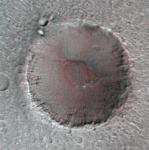 Mars: Big Crater in Stereo
30.04.1998
Get out your red/blue glasses and check out this stereo picture of "Big Crater" on Mars! (Pieces of red and blue or green clear plastic will do. Your right eye should look through...
 Missoula Crater on Mars
4.05.2004
Scroll right to see the rocks, craters, and hills that were in view for the Spirit rover last week as it continued its trek across Mars. Missoula crater, taking up much of the above frame, appeared from orbit to have ejecta from Bonneville crater inside it.
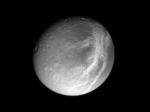 Saturns Moon Dione from Cassini
30.11.2004
What causes the bright streaks on Dione? Recent and likely future images of this unusual moon by the robot Cassini spacecraft now orbiting Saturn might help us find out. The above image was taken at the end of October from a distance of about one million kilometers.
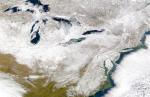 Snowstorm on Planet Earth
30.01.2000
Earth is an ocean planet. From low Earth orbit, the Sea-viewing Wide Field-of-view Sensor (SeaWiFS) instrument onboard NASA's SeaStar spacecraft globally maps ocean color, tracking changes in the climate and biosphere of our water world.
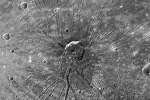 A Spider Shaped Crater on Mercury
3.02.2008
Why does this crater on Mercury look like a spider? When the robotic MESSENGER spacecraft glided by the planet Mercury last month, it was able to image portions of the Sun's closest planet that had never been seen before.
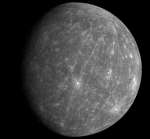 Mercury as Revealed by MESSENGER
8.10.2008
The planet Mercury has been known since history has been recorded, but parts of the Solar System's innermost planet have never been seen like this before. Two days ago the robotic MESSENGER spacecraft buzzed past Mercury for the second time and imaged terrain mapped previously only by comparatively crude radar.
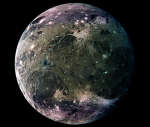 Ganymede Enhanced
20.09.2009
What does the largest moon in the Solar System look like? Ganymede, larger than even Mercury and Pluto, has a surface speckled with bright young craters overlying a mixture of older, darker, more cratered terrain laced with grooves and ridges.
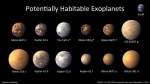 Habitable Worlds
3.03.2014
Is Earth the only known world that can support life? In an effort to find life-habitable worlds outside our Solar System, stars similar to our Sun are being monitored for slight light decreases that indicate eclipsing planets. Many previously-unknown planets are being found, including over 700 worlds recently uncovered by NASA's Kepler satellite.
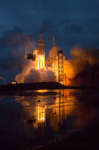 Orion Launch
5.12.2014
Headed for two orbits of planet Earth and a splashdown in the Pacific, Orion blazed into the early morning sky on Friday at 7:05am ET. The spacecraft was launched atop a United Launch Aliance Delta IV Heavy rocket from Cape Canaveral Air Force Station in Florida.
|
January February March April May June July August September |
|||||||||||||||||||||||||||||||||||||||||||||||||