
|
You entered: orbit
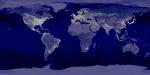 Earth at Night
10.08.2002
This is what the Earth looks like at night. Can you find your favorite country or city? Surprisingly, city lights make this task quite possible. Human-made lights highlight particularly developed or populated areas of the Earth's surface, including the seaboards of Europe, the eastern United States, and Japan.
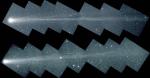 Comet NEAT Approaches the Sun
10.02.2003
A comet may likely become visible to the unaided eye over the next few days above the horizon where the Sun has just set. Comet NEAT (C/ 2002 V1), discovered last November, has brightened dramatically as it approached the Sun.
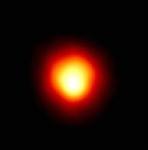 Betelgeuse, Betelgeuse, Betelgeuse
16.02.1997
Betelgeuse (sounds a lot like "beetle juice"), a red supergiant star about 600 light years distant, is seen in this Hubble Space Telescope image -- the first direct picture of the surface of a star other than the Sun. A bright, as yet unexplained hotspot is revealed on its surface!
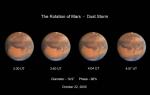 October Mars
28.10.2005
This October, Mars has become a bright, yellowish star in planet Earth's sky as it approaches oppositon, the period when Mars and Earth pass close as they orbit the Sun. How close is Mars? A mere 70 million kilometers or so, close enough to allow Earth-bound astronomers excellent views of the alluring Red Planet.
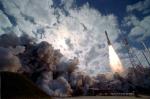 New Horizons Launches to Pluto
24.01.2006
Destination: Pluto. The New Horizons spacecraft roared off its launch pad at Cape Canaveral in Florida, USA last week toward adventures in the distant Solar System. The craft is one of the fastest spaceships...
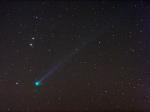 Unexpected Comet Pojmanski Now Visible
6.03.2006
Have you ever seen a comet? Comets bright enough to be visible to the unaided eye appear only every few years. Right now, however, a new comet has brightened unexpectedly and is visible as a faint streak to the unaided northern observer in the eastern morning sky just before sunrise. Binoculars may help.
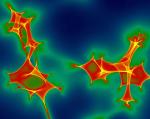 A Network of Microlensing Caustics
24.08.1999
A virtual sky map like this would be of interest to astronomers studying gravitational microlensing. In microlensing, the gravity of stars near the line of sight can act to magnify the light of background objects such as distant stars, or quasars. Nowhere is this magnification greater than near a gravitational lensing caustic.
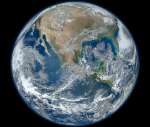 Blue Marble Earth from Suomi NPP
30.01.2012
Behold one of the more detailed images of the Earth yet created. This Blue Marble Earth montage shown above -- created from photographs taken by the Visible/Infrared Imager Radiometer Suite (VIIRS) instrument on board the new Suomi NPP satellite -- shows many stunning details of our home planet.
 Saturns Moon Helene in Color
2.05.2012
Although its colors may be subtle, Saturn's moon Helene is an enigma in any light. The moon was imaged in unprecedented detail last June as the robotic Cassini spacecraft orbiting Saturn swooped to within a single Earth diameter of the diminutive moon.
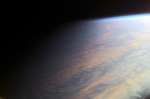 Earth at Twilight
6.04.2013
No sudden, sharp boundary marks the passage of day into night in this gorgeous view of ocean and clouds over our fair planet Earth. Instead, the shadow line or terminator is diffuse and shows the gradual transition to darkness we experience as twilight.
|
January February March April May June July August September |
|||||||||||||||||||||||||||||||||||||||||||||||||