
|
You entered: orbit
 Warped Spiral Galaxy ESO510 13
12.05.1999
How did spiral galaxy ESO510-13 get bent out-of-shape? The disks of many spirals are thin and flat, but not solid. Spiral disks are loose conglomerations of billions of stars and diffuse gas all gravitationally orbiting a galaxy center.
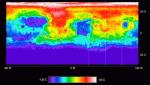 Thermal Mars
2.06.1999
It's 2 AM on Mars and surface temperatures range from -65C to -120C, as measured by the Thermal Emission Spectrometer (TES) onboard the Mars Global Surveyor spacecraft. TES data used...
 Possible Methane Lakes on Titan
31.07.2006
Have methane lakes been discovered on Saturn's Titan? That exciting possibility was uncovered from analyses of radar images returned last week by the robotic Cassini spacecraft now orbiting Saturn. The above image is a radar reflection from terrain near Titan's North Pole and spans a region about 200 kilometers across.
 A Twisted Solar Eruptive Prominence
3.04.2000
A huge eruptive prominence is seen moving out from our Sun in this condensed half-hour time-lapse sequence. Ten Earths could easily fit in the "claw" of this seemingly solar monster. This large prominence, though, is significant not only for its size, but its shape.
 A Tether in Space
7.01.2018
One of the greatest unrequited legends of outer space is the tether. Tethers, long strands of material, hold the promise of stabilizing satellites, generating electricity, and allowing easy transportation. Possibly the most ambitious vision of the space tether is the space elevator popularized by Arthur C.
 Stardust and Comet Tails
20.08.2022
Heading for its closest approach to the Sun, or perihelion, on December 19 comet C/2017 K2 (PanSTARRS) remains a sight for telescopic observers as it sweeps through planet Earth's skies in the constellation Scorpius.
 Sky Full of SARs
17.08.2024
On August 11 a Rocket Lab Electron rocket launched from a rotating planet. With a small satellite on board its mission was dubbed A Sky Full of SARs (Synthetic Aperture Radar satellites), departing for low Earth orbit from Mahia Peninsula on New Zealand's north island.
 Deimos Before Sunrise
24.05.2025
Deimos takes 30 hours and 18 minutes to complete one orbit around the Red Planet. That's a little more than one Martian day or sol which is about 24 hours and 40 minutes long, so Deimos drifts westward across the Martian sky.
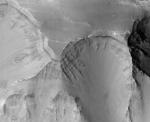 In A Grand Canyon On Mars
12.02.1998
In a grand canyon on Mars, steep slopes fall away from a smooth plateau revealing striking layered rock formations. The canyon is part of the Valles Marineris, a 2,500 mile long system of canyons cutting across the Martian equator.
 The Regolith of Asteroid Eros
3.03.2002
From fifty kilometers above asteroid Eros, the surface inside one of its largest craters appears covered with an unusual substance: regolith. The thickness and composition of the surface dust that is regolith remains a topic of much research.
|
January February March April May June July August September |
|||||||||||||||||||||||||||||||||||||||||||||||||