
|
You entered: dark
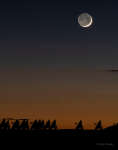 The Old Moon in the Young Moon s Arms
10.11.2018
Tonight the Moon is young again, but this stunning image of a young Moon near the western horizon was taken just after sunset on October 10. On the lunar disk Earthshine, earthlight reflected from the Moon's night side, is embraced by the slim, sunlit crescent just over 2 days old.
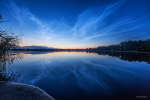 The Veins of Heaven
26.07.2019
Transfusing sunlight through a still dark sky, this exceptional display of noctilucent clouds was captured earlier this month, reflected in the calm waters of Vallentuna Lake near Stockholm, Sweden. From the edge of space...
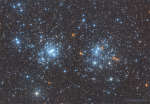 A Double Star Cluster in Perseus
22.11.2022
Few star clusters this close to each other. Visible to the unaided eye from dark sky areas, it was cataloged in 130 BC by Greek astronomer Hipparchus. Some 7,000 light-years away, this pair...
 APOD: 2024 January 22 Б Shadows of Mountain and Moon
22.01.2024
Can the Moon and a mountain really cast similar shadows? Yes, but the division between light and dark does not have to be aligned. Pictured, a quarter moon was captured above the mountain Grivola in Italy in early October of 2022.
 APOD: 2025 August 7 Б The Double Cluster in Perseus
7.08.2025
This stunning starfield spans about three full moons (1.5 degrees) across the heroic northern constellation of Perseus. It holds the famous pair of open star clusters, h and Chi Persei. Also cataloged...
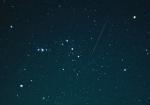 A 2000 Leonid Through Orion
20.11.2000
The Leonid Meteor Shower this year could be described as good but not great. During November 17 and 18 the Earth crossed through several streams of sand-sized grit left orbiting the Sun by Comet Tempel-Tuttle. Several distinct peaks in meteor activity were reported, with
 Antares and Rho Ophiuchi
22.09.1997
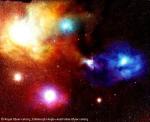
Why is the sky near Antares and Rho Ophiuchi so colorful? The colors result from a mixture of objects and processes. Fine dust illuminated from the front by starlight produces blue reflection nebulae. Gaseous clouds whose atoms are excited by ultraviolet starlight produce reddish emission nebulae. Backlit dust clouds block starlight and so appear dark.
 The Long Shadow of the Moon
27.11.2003
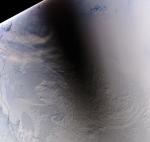
The long shadow of the Moon fell across the continent of Antarctica on November 23rd, during the second total solar eclipse of 2003. In this view from orbit, based on data from the MODIS instrument on board the Earth observing Aqua satellite, the Moon's shadow stretches for almost 500 kilometers.
 Jupiter Swallows Comet Shoemaker Levy 9
4.08.1998
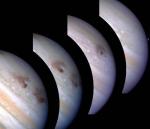
What happens when a comet encounters a planet? If the planet has a rocky surface, a huge impact feature will form. A giant planet like Jupiter, however, is mostly gas. When Comet Shoemaker-Levy 9 struck Jupiter in 1994, each piece was swallowed into the vast Jovian atmosphere.
 Nozomi: Earth and Moon
4.09.1998
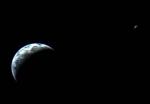
Japan launched its first mission to orbit Mars, Nozomi (Hope), on July 3rd from the Kagoshima Space Center on the island of Kyushu. Nozomi's goal is to explore the Martian atmosphere and magnetic field as well as regions of the planet's surface and moons.
|
January February March April May June July August September |
|||||||||||||||||||||||||||||||||||||||||||||||||