
|
You entered: dark
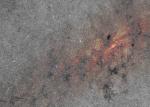 The Galactic Center in Infrared
8.07.2001
The center of our Galaxy is a busy place. In visible light, much of the Galactic Center is obscured by opaque dust. In infrared light, however, dust glows more and obscures less, allowing nearly one million stars to be recorded in the above photograph.
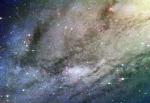 Southwest Andromeda
17.09.2001
This new image composite of the southwest region of M31 from the Subaru Telescope shows many stars, nebulae, and star clusters never before resolved. An older population of stars near Andromeda's center causes the yellow hue visible on the upper right. Young blue stars stand out in the spiral arms on the lower left.
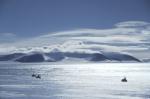 Searching for Meteorites in Antarctica
26.12.2002
Where is the best place on Earth to find meteorites? Although meteors fall all over the world, they usually just sink to the bottom of an ocean, are buried by shifting terrain, or are easily confused with terrestrial rocks.
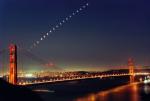 Copper Moon, Golden Gate
21.05.2003
When the Moon rose over San Francisco's Golden Gate Bridge on May 15, both bridge and Moon were in already in Earth's shadow. Of course, the bridge is in the Earth's shadow nightly, while the Moon only has that opportunity twice a year, during a lunar eclipse.
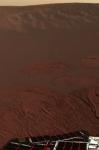 A Landing at Meridiani Planum
26.01.2004
After an interplanetary journey of nearly 300 million miles, Opportunity bounced down on the martian surface at about 9:05 pm PST Saturday, its final plunge cushioned by airbags. Now the second NASA rover...
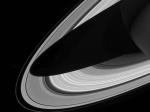 A Shadow on the Rings of Saturn
21.07.2004
This picture of Saturn could not have been taken from Earth. No Earth based picture could possibly view the night side of Saturn and the corresponding shadow cast across Saturn's rings. Since Earth is much closer to the Sun than Saturn, only the day side of the planet is visible from the Earth.
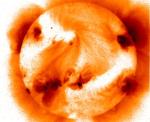 Perihelion Sun
11.01.1999
The Earth's orbit is not a perfect, sun-centered circle. At aphelion, the most distant point in Earth's orbit, the Sun is 150 million kilometers away and at perihelion, the closest point, Earth approaches the Sun to within about 147 million kilometers. While aphelion occurs in July, perihelion for planet Earth comes in January.
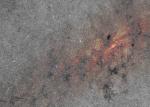 The Galactic Center in Infrared
7.11.2004
The center of our Galaxy is a busy place. In visible light, much of the Galactic Center is obscured by opaque dust. In infrared light, however, dust glows more and obscures less, allowing nearly one million stars to be recorded in the above photograph.
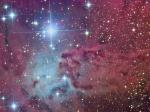 The Fox Fur Nebula
14.03.2005
The nebula surrounding bright star S Mon is filled with dark dust and glowing gas. The strange shapes originate from fine interstellar dust reacting in complex ways with the energetic light and hot gas being expelled by the young stars.
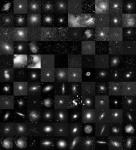 Messier Marathon
18.03.1999
Gripped by an astronomical spring fever, this week many amateur stargazers embark on a Messier Marathon. The Vernal Equinox occurs Saturday, March 20, marking the first day of Spring for the Northern Hemisphere.
|
January February March April May June July August September |
|||||||||||||||||||||||||||||||||||||||||||||||||