
|
You entered: time
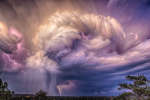 Lightning over Colorado
27.09.2020
Have you ever watched a lightning storm in awe? Join the crowd. Oddly, details about how lightning is produced remains a topic of research. What is known is that updrafts carry light ice crystals into collisions with larger and softer ice balls, causing the smaller crystals to become positively charged.
 APOD: 2025 March 30 Б A Partial Solar Eclipse over Iceland
30.03.2025
What if the Sun and Moon rose together? That happened yesterday over some northern parts of planet Earth as a partial solar eclipse occurred shortly after sunrise. Regions that experienced the Moon blocking part of the Sun included northeastern parts of North America and northwestern parts of Europe, Asia, and Africa.
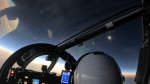 APOD: 2026 September 5 Б Chasing the Moon s Shadow
5.09.2026
Chasing the shadow of a New Moon, NASAБs WB-57F high altitude research aircraft took to the skies off the coast of Iceland on August 12 to observe a total solar eclipse. At 50,000 feet the aircraft was piloted along the precisely determined path of totality to maximize its time in the MoonБs shadow.
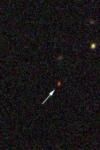 High Redshift Quasars
11.12.1998
Each red speck indicated above is a powerful quasar estimated to be over 100 times brighter than a galaxy. Yet in these Sloan Digital Sky Survey discovery images the quasars appear faint because they are extremely distant.
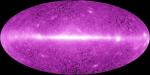 The Gamma Ray Sky
12.01.2002
What if you could see gamma rays? If you could, the sky would seem to be filled with a shimmering high-energy glow from the most exotic and mysterious objects in the Universe.
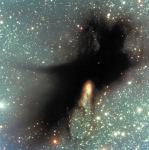 BHR 71: Stars, Clouds, and Jets
27.01.2003
What is happening to molecular cloud BHR 71? Quite possible, a binary star system is forming inside. Most stars in our Galaxy are part of binary star systems, but few have ever been seen in formation.
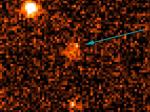 GRB Fireball Persists
17.09.1997
It's still there. The optical counterpart to the instantly famous gamma-ray burst (GRB) that occurred last February 28th has faded - but not completely. The astronomical community had waited patiently for months...
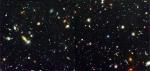 The Hubble Deep Field
7.06.1998
Galaxies like colorful pieces of candy fill the Hubble Deep Field - humanity's most distant yet optical view of the Universe. The dimmest, some as faint as 30th magnitude (about four billion times fainter...
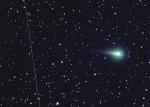 Announcing Comet C 2002 T7 LINEAR
9.02.2004
A newly discovered comet may outshine most stars in the sky by May. Designated Comet C/2002 T7 (LINEAR), the comet was discovered in 2002 October by project LINEAR. Many reports already place the comet as brighter than magnitude 7, meaning that it can now be seen with binoculars.
 Thin Rings Around Polarized Saturn
19.12.2005
How thin are the rings of Saturn? Brightness measurements from different angles have shown Saturn's rings to be about one kilometer thick, making them many times thinner, in relative proportion, than a razor blade. This thinness sometimes appears in dramatic fashion during an image taken nearly along the ring plane.
|
January February March April May June July August September |
|||||||||||||||||||||||||||||||||||||||||||||||||