
|
You entered: time
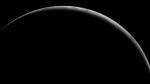 A Crescent Earth at Midnight
21.06.2003
The Earth's northern hemisphere is outlined as a sunlit crescent in this dramatic view from orbit, recorded near local midnight by the Geostationary Operational Environmental Satellite (GOES-8) on June 22, 1996. That...
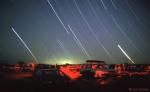 Star Party Trails
21.05.1999
Stargazing is fun! If you'd like to try it, this weekend may be your chance as many astronomy clubs and organizations will be hosting public celebrations of Astronomy Day on Saturday, May 22nd. In recent years, open house nights at observatories, astronomy club gatherings, and star parties have become increasingly popular.
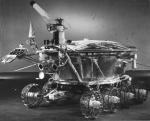 Lunokhod: Moon Robot
14.01.2006
On November 17, 1970 the Soviet Luna 17 spacecraft landed the first roving remote-controlled robot on the Moon. Known as Lunokhod 1, it weighed just under 2,000 pounds and was designed to operate...
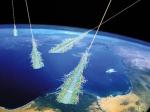 Cosmic Rays
14.08.2006
Have you ever been hit by a beam of high energy particles from above? Surely you have -- it happens all of the time. Showers of high energy particles occur when energetic cosmic rays strike the top of the Earth's atmosphere. Cosmic rays were discovered unexpectedly in 1912.
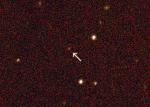 Redshift 5.8: A New Farthest Quasar
19.04.2000
The distance record for a quasar has been broken yet again. At the present time, no other object in the universe has been found to be more distant than the above speck. The recently discovered quasar has been clocked at redshift 5.82.
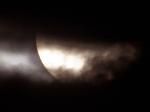 Mercurys Transit: An Unusual Spot on the Sun
14.11.2006
What's that dot on the Sun? If you look closely, it is almost perfectly round. The dot is the result of an unusual type of solar eclipse that occurred last week. Usually it is the Earth's Moon that eclipses the Sun.
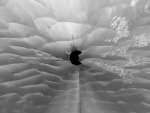 Martian Dunes and the Shadow of Opportunity
24.03.2009
Human made robots continue to roll across the surface of Mars. Both Opportunity and its sister rover Spirit are in their sixth year on Mars, exploring the red planet for years longer than original expectations.
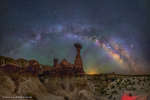 The Milky Way Over the Arizona Toadstools
22.02.2015
Which is older -- the rocks you see on the ground or the light you see from the sky? Usually its the rocks that are older, with their origin sentiments deposited well before light left any of the stars or nebulas you see in the sky.
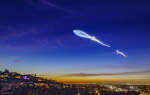 SpaceX Rocket Launch Plume over California
24.12.2017
What's happened to the sky? On Friday, the photogenic launch plume from a SpaceX rocket launch created quite a spectacle over parts of southern California and Arizona. Looking at times like a giant...
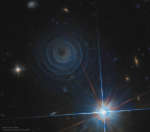 The Extraordinary Spiral in LL Pegasi
8.07.2018
What created the strange spiral structure on the upper left? No one is sure, although it is likely related to a star in a binary star system entering the planetary nebula phase, when its outer atmosphere is ejected.
|
January February March April May June July August September |
|||||||||||||||||||||||||||||||||||||||||||||||||