
|
You entered: time
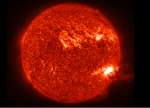 The Sun Unleashed: Monster Filament in Ultraviolet
9.04.2018
One of the most spectacular solar sights is an explosive flare. In 2011 June, the Sun unleashed somewhat impressive, medium-sized solar flare as rotation carried active regions of sunpots toward the solar limb. That...
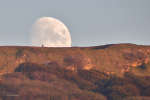 Biking to the Moon
2.10.2020
As you watched October's first Full Moon rise last night, the Full Moon closest to the northern autumnal equinox, you were probably asking yourself, "How long would it take to bike...
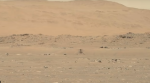 Ingenuity: First Flight over Mars
20.04.2021
What's the best way to explore Mars? Perhaps there is no single best way, but a newly demonstrated method shows tremendous promise: flight. Powered flight has the promise to search vast regions and scout out particularly interesting areas for more detailed investigation.
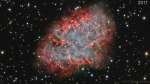 APOD: 2023 March 20 Б M1: The Expanding Crab Nebula
20.03.2023
Are your eyes good enough to see the Crab Nebula expand? The Crab Nebula is cataloged as M1, the first on Charles Messier's famous list of things which are not comets. In fact...
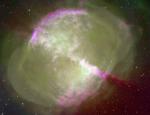 M27: The Dumbbell Nebula
6.03.2001
The first hint of what will become of our Sun was discovered inadvertently in 1764. At that time, Charles Messier was compiling a list of "annoying" diffuse objects not to be confused with "interesting" comets.
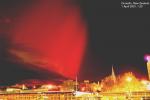 Aurora Over New Zealand
6.04.2001
Last weekend skygazers at middle and high latitudes around the globe were treated to expansive auroral displays as a magnetic storm raged around planet Earth. The storm was triggered by a solar coronal mass ejection associated with the giant sunspot group cataloged as active region number 9393.
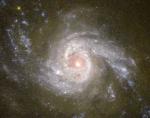 Spiral Galaxy NGC 3310 Across the Visible
11.09.2001
The party is still going on in spiral galaxy NGC 3310. Roughly 100 million years ago, NGC 3310 likely collided with a smaller galaxy causing the large spiral galaxy to light up with a tremendous burst of star formation.
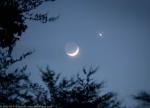 Love and War by Moonlight
24.05.2002
Venus, named for the Roman goddess of love, and Mars, the war god's namesake, approach each other by moonlight in this lovely sky view recorded on May 14th from Dunkirk, Maryland, USA.
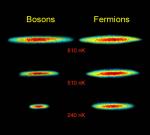 Pauli Exclusion Principle: Why You Don't Implode
19.02.2003
Why doesn't matter just bunch up? The same principle that keeps neutron stars and white dwarf stars from imploding also keeps people from imploding and makes normal matter mostly empty space. The observed reason is known as the Pauli Exclusion Principle.
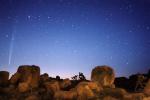 Comets Bradfield and LINEAR Rising
3.05.2004
Comet Bradfield is easy to see on the left, but can you find Comet LINEAR on the right? Last week, just before sunrise from the northern hemisphere, two bright comets were visible in the same part of the sky at the same time.
|
January February March April May June July August September |
|||||||||||||||||||||||||||||||||||||||||||||||||