
|
You entered: pole
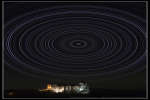 Lewins Challenge: 360 Degree Star Trails
17.07.2011
You could be the first person ever to take a real single-exposure image like this. The above image from Vienna, Austria is not real in the sense that the 360 degree star trails in the sky appear only because of a digital trick.
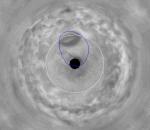 Jupiter's Great Dark Spot
19.03.2003
Seventeenth century astronomer Giovanni Domenico Cassini was an astute observer of Jupiter's Great Red Spot. So it seems only fitting that his namesake, the Cassini spacecraft, has enabled detailed observations of another planet-sized blemish -- Jupiter's Great Dark Spot.
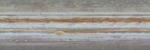 Jupiter Unpeeled
15.02.2001
Slice Jupiter from pole to pole, peel back its outer layers of clouds, stretch them onto a flat surface ... and for all your trouble you'd end up with something that looks a lot like this. Scrolling right will reveal the full picture, a color mosaic of Jupiter from the Cassini spacecraft.
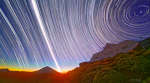 APOD: 2026 March 20 Б Spring Equinox at Teide Observatory
20.03.2026
The defining astronomical moment of the equinox today is at 14:46 UTC (March 20). That's when the Sun crosses the celestial equator moving north in its yearly journey through planet Earth's sky, marking the beginning of spring for our fair planet in the northern hemisphere and fall in the southern hemisphere.
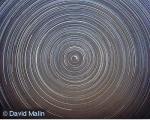 Star Trails in Northern Skies
12.09.1998
As the Earth spins on its axis, the sky seems to rotate around us. This motion produces the beautiful concentric trails traced by the stars in this time exposure of the night sky.
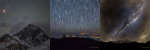 Highest, Tallest, and Closest to the Stars
25.02.2016
Fans of planet Earth probably recognize its highest mountain, the Himalayan Mount Everest, on the left in this 3-panel skyscape of The World at Night. Shrouded in cloud Everest's peak is at 8,848 meters (29,029 feet) elevation above sea level.
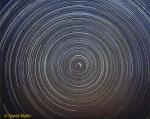 Star Trails in Northern Skies
1.12.1996
As the Earth spins on its axis, the sky seems to rotate around us. This motion produces the beautiful concentric arcs traced out by the stars in this time exposure of the night sky.
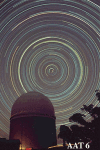 Star Trails in Southern Skies
26.09.1995
As the Earth spins on its axis, the sky seems to rotate around us. This motion produces the beautiful concentric arcs traced out by the stars in this time exposure of the night sky. In the foreground of the picture is the dome of the Anglo-Australian Telescope in central New South Wales Australia.
 The Case of the Missing Aurora
21.10.1998
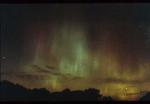
Sometimes, near midnight, auroras suddenly stop. Nobody knows why. This nightside gap in aurora was confirmed recently by D. Chua (U. Washington) and colleagues in data from the Ultraviolet Imager onboard the Polar spacecraft.
 Aurora Above
11.11.1998
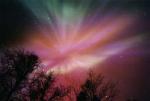
On some nights the sky is the most interesting show in town. This picture captures a particularly active and colorful display of aurora that occurred a month ago high above Alaska. Auroras are more commonly seen by observers located near the Earth's poles.
|
January February March April May June July August September |
|||||||||||||||||||||||||||||||||||||||||||||||||