
|
You entered: pole
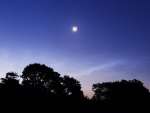 Night Shinings
2.07.2008
In the early morning hours of June 30th, ghostly clouds hovered in the east in this view of near dawn skies over western France. The noctilucent or night-shining clouds lie near the edge of space, reflecting sunlight from about 80 kilometers above Earth's surface.
 Southern Moonscape
30.08.2024
The Moon's south pole is toward the top left of this detailed telescopic moonscape. Captured on August 23, it looks across the rugged southern lunar highlands. The view's foreshortened perspective heightens the impression of a dense field of craters and makes the craters themselves appear more oval shaped close to the lunar limb.
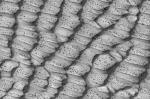 APOD: 2007 August 5- The Dotted Dunes of Mars
5.08.2007
What causes the black dots on dunes on Mars? As spring dawned on the Northern Hemisphere of Mars in 2004, dunes of sand near the poles begin to defrost. Thinner regions of ice typically thaw first revealing sand whose darkness soaks in sunlight and accelerates the thaw.
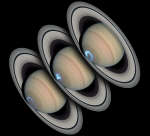 Persistent Saturnian Auroras
22.06.2014
Are Saturn's auroras like Earth's? To help answer this question, the Hubble Space Telescope and the Cassini spacecraft monitored Saturn's South Pole simultaneously as Cassini closed in on the gas giant in January 2004. Hubble snapped images in ultraviolet light, while Cassini recorded radio emissions and monitored the solar wind.
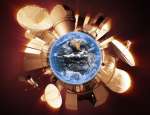 Around the World in 80 Telescopes
3.04.2009
Want to go on an extraordinary voyage? Today you can, by watching Around the World in 80 Telescopes. The 24-hour long webcast is organized by the European Southern Observatory for the International Year of Astronomy cornerstone project 100 Hours of Astronomy.
 The Northern Milky Way
25.08.2003
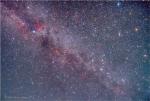
Many of the stars in our home Milky Way Galaxy appear together as a dim band on the sky that passes nearly over the Earth's north and south poles. Pictured above is the part of our Galaxy that passes closest over the north pole.
 Night Shining Clouds
5.07.2007
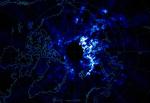
Alluring noctilucent or night-shining clouds lie near the edge of space, some 80 kilometers above Earth's surface. Of course, when viewed from space the clouds are more properly called polar mesospheric clouds (PMCs) -- seen here for the first time in image data from the Aeronomy of Ice in the Mesosphere (AIM) satellite.
 Aurorae on Jupiter
11.07.2016
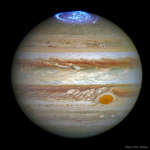
Jupiter has aurorae. Like Earth, the magnetic field of the gas giant funnels charged particles released from the Sun onto the poles. As these particles strike the atmosphere, electrons are temporarily knocked away from existing gas molecules. Electric force attracts these electrons back. As the electrons recombine to remake neutral molecules, auroral light is emitted.
 All of Mars
26.06.2001
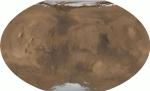
From pole to pole, from east to west, this is all of Mars. The above picture was digitally reconstructed from over 200 million laser altimeter measurements taken by the Mars Global Surveyor spacecraft currently orbiting Mars.
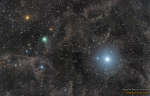 Polaris and Comet Lovejoy
2.06.2015
One of these two bright sky objects is moving. On the right is the famous star Polaris. Although only the 45th brightest star in the sky, Polaris is famous for appearing stationary. Once you find it, it will always appear in the same direction -- all night and all day -- for the rest of your life.
|
January February March April May June July August September |
|||||||||||||||||||||||||||||||||||||||||||||||||