
|
You entered: pole
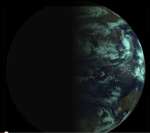 Earth at Equinox
22.09.2014
Earth is at equinox. Over the next 24 hours, day and night have nearly equal duration all over planet Earth. Technically, equinox transpires at 2:29 am Universal Time tomorrow, but this occurs today in North and South America.
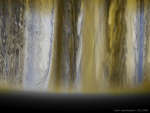 Jupiters Clouds from New Horizons
25.06.2016
The New Horizons spacecraft took some stunning images of Jupiter on its way out to Pluto. Famous for its Great Red Spot, Jupiter is also known for its regular, equatorial cloud bands, visible through even modest sized telescopes.
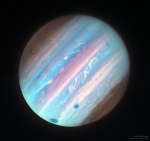 Jupiter in Ultraviolet from Hubble
15.10.2018
Jupiter looks a bit different in ultraviolet light. To better interpret Jupiter's cloud motions and to help NASA's robotic Juno spacecraft understand the planetary context of the small fields that it sees, the Hubble Space Telescope is being directed to regularly image the entire Jovian giant.
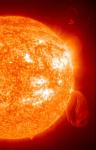 Maximum Sun
28.02.2001
Astronomers recently witnessed an astounding, large scale solar event as the Sun's north and south magnetic poles changed places! But, this complete solar magnetic field flip was actually anticipated. It occurs every 11 years during the maximum of the solar activity cycle.
 Destination: Moon
7.01.1998
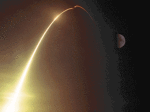
Tuesday, January 6, at 9:28 p.m. EST, NASA's Lunar Prospector spacecraft climbed into the sky above Cape Canaveral Air Station riding an Athena II rocket. Representing NASA's first Moon mission since...
 Thirty Thousand Kilometers Above Enceladus
16.03.2008
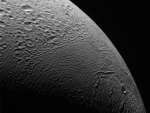
What does the surface of Saturn's ice-spewing moon Enceladus look like? To help find out, the robotic Cassini spacecraft now orbiting Saturn was sent soaring past the cryovolcanic moon and even right through one of Enceladus' ice plumes. Cassini closed to about 52 kilometers during its closest encounter to date.
 APOD: 2026 May 13 Б NGC 188: Old Cluster in the New General Catalog
12.05.2026
The New General Catalog of star clusters and nebulae really isn't so new. In fact, it was published in 1888 - an effort by J. L. E. Dreyer to consolidate the work of astronomers William, Caroline, and John Herschel along with others into a useful single, complete catalog of astronomical discoveries and measurements.
 Cosmic Microwave Map Swirls Indicate Inflation
18.03.2014
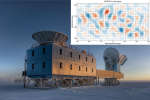
Did the universe undergo an early epoch of extremely rapid expansion? Such an inflationary epoch has been postulated to explain several puzzling cosmic attributes such as why our universe looks similar in opposite directions.
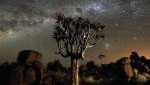 Namibian Nights
4.02.2013
Namibia has some of the darkest nights visible from any continent. It is therefore home to some of the more spectacular skyscapes, a few of which have been captured in the above time-lapse video.
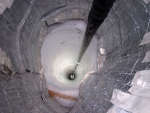 Ice Fishing for Cosmic Neutrinos
12.02.2011
Scientists are melting holes in the bottom of the world. In fact, almost 100 holes melted near the South Pole are now being used as astronomical observatories. Astronomers with the IceCube Neutrino Observatory lowered into each vertical lake a long string knotted with basketball-sized light detectors. The water in each hole soon refreezes.
|
January February March April May June July August September |
|||||||||||||||||||||||||||||||||||||||||||||||||