
|
You entered: orbit
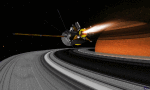 Cassini To Saturn
29.08.1997
Scheduled for launch in October, the Cassini spacecraft will spend seven years traveling through the Solar System -- its destination, Saturn. On arrival Cassini will begin an ambitious mission of exploration which will include parachuting a probe to the surface of Titan, Saturn's largest moon.
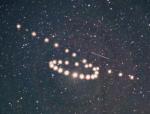 Retrograde Mars
16.12.2003
Why would Mars appear to move backwards? Most of the time, the apparent motion of Mars in Earth's sky is in one direction, slow but steady in front of the far distant stars. About every two years, however, the Earth passes Mars as they orbit around the Sun.
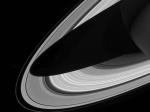 A Shadow on the Rings of Saturn
21.07.2004
This picture of Saturn could not have been taken from Earth. No Earth based picture could possibly view the night side of Saturn and the corresponding shadow cast across Saturn's rings. Since Earth is much closer to the Sun than Saturn, only the day side of the planet is visible from the Earth.
 Genesis Missions Hard Impact
14.09.2004
A flying saucer from outer space crash-landed in the Utah desert last week after being tracked by radar and chased by helicopters. No space aliens were involved, however. The saucer, pictured above...
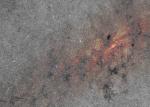 The Galactic Center in Infrared
7.11.2004
The center of our Galaxy is a busy place. In visible light, much of the Galactic Center is obscured by opaque dust. In infrared light, however, dust glows more and obscures less, allowing nearly one million stars to be recorded in the above photograph.
 Aeolian Mars
2.02.2000
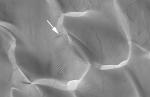
Mars' atmosphere is relatively thin, still when martian winds blow they weather and shape its surface. Like familiar aeolian features on Earth, this field of dunes within Mars' Rabe crater exhibits graceful undulating ridges which can shift as windblown material is deposited on the dunes' windward face and falls away down the steeper leeward slopes.
 APOD: 2007 August 1- Unusual Cratering on Saturns Dione
1.08.2007
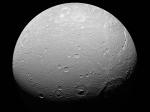
Why does one half of Dione have more craters than the other? Start with the fact that Saturn's moon Dione always has one side that faces Saturn, and always has one side that faces away. This is similar to Earth's Moon.
 700 Kilometers Below Comet Hartley 2
8.11.2010
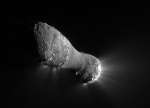
What kind of comet is this? Last week, NASA's robotic EPOXI spacecraft whizzed past Comet 103P/Hartley, also known as Comet Hartley 2, and recorded images and data that are both strange and fascinating. EPOXI was near its closest approach -- about 700 kilometers away -- when it snapped the above picture.
 A Dust Devil of Mars
13.04.2012
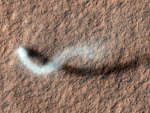
It was late in the northern martian spring when the HiRISE camera onboard the Mars Reconnaissance Orbiter spied this local denizen. Tracking south and east (down and right) across the flat, dust-covered Amazonis Planitia the core of the whirling dust devil is about 30 meters in diameter.
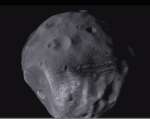 Phobos 360
25.12.2013
What does the Martian moon Phobos look like? To better visualize this unusual object, images from ESA's Mars Express orbiter have been combined into a virtual rotation movie. The rotation is actually a digital illusion -- tidally-locked Phobos always keeps the same face toward its home planet, as does Earth's moon.
|
January February March April May June July August September |
|||||||||||||||||||||||||||||||||||||||||||||||||