
|
You entered: orbit
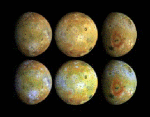 Three Views of Jupiter's Io
3.10.1996
The Galileo spacecraft orbiting Jupiter continues to return impressive results. The Galileo team has just released three more photographs of Jupiter's volcanic moon Io taken in June. These three photos are reflected at the bottom of the above picture, digitally enhanced to better show important features.
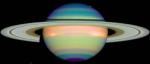 Infrared Saturn
24.04.1998
This delightfully detailed false color image of Saturn has been earmarked to celebrate the 8th anniversary of the orbiting Hubble Space Telescope. The picture is a combination of three images taken in January of this year with the Hubble's new NICMOS instrument and shows the lovely ringed planet in reflected infrared light.
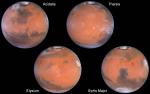 Four Faces of Mars
5.07.1999
As Mars rotates, most of its surface becomes visible. During Earth's recent pass between Mars and the Sun, the Hubble Space Telescope was able to capture the most detailed time-lapse pictures ever from the Earth. Dark and light sand and gravel create an unusual blotted appearance for the red planet.
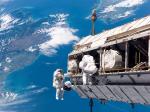 Upgrading the International Space Station
25.12.2006
The International Space Station (ISS) will be the largest human-made object ever to orbit the Earth. The station is so large that it could not be launched all at once -- it is being built piecemeal with large sections added continually by flights of the Space Shuttle.
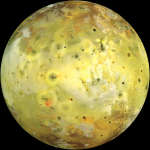 Io in True Color
3.10.2010
The strangest moon in the Solar System is bright yellow. This picture, an attempt to show how Io would appear in the "true colors" perceptible to the average human eye, was taken in 1999 July by the Galileo spacecraft that orbited Jupiter from 1995 to 2003.
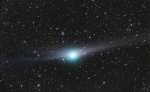 Another Tail for Comet Garradd
3.03.2012
Remarkable comet Garradd (C2009/P1) has come to be known for two distinctive tails. From the perspective of earthbound comet watchers the tails are visible on opposite sides of its greenish coma. Seen here in a telescopic view, the recognizable dust tail fans out to the right, trailing the comet nucleus in its orbit.
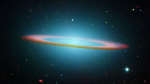 The Sombrero Galaxy in Infrared
11.03.2012
This floating ring is the size of a galaxy. In fact, it is part of the photogenic Sombrero Galaxy, one of the largest galaxies in the nearby Virgo Cluster of Galaxies. The dark band of dust that obscures the mid-section of the Sombrero Galaxy in optical light actually glows brightly in infrared light.
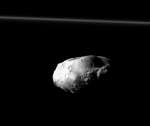 Prometheus and the F Ring
8.01.2016
In Greek myth Prometheus was a Titan, known for bringing fire from Mount Olympus. But in modern times the name is given to is a small moon of Saturn, orbiting just inside Saturn's F ring.
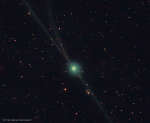 Almost Three Tails for Comet Encke
20.02.2017
How can a comet have three tails? Normally, a comet has two tails: an ion tail of charged particles emitted by the comet and pushed out by the wind from...
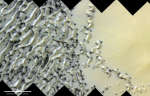 Sand Dunes Thawing on Mars
24.09.2019
What are these strange shapes on Mars? Defrosting sand dunes. As spring dawned on the Northern Hemisphere of Mars, dunes of sand near the pole, as pictured here in late May by ESA's ExoMars Trace Gas Orbiter, began to thaw.
|
January February March April May June July August September |
|||||||||||||||||||||||||||||||||||||||||||||||||