
|
You entered: orbit
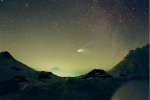 Comet Hale Bopp Over Val Parola Pass
2.03.2008
Comet Hale-Bopp, the Great Comet of 1997, became much brighter than any surrounding stars. It was seen even over bright city lights. Away from city lights, however, it put on quite a spectacular show. Here Comet Hale-Bopp was photographed above Val Parola Pass in the Dolomite mountains surrounding Cortina d'Ampezzo, Italy.
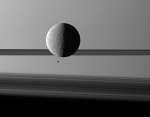 Moons and Rings Before Saturn
31.05.2010
While cruising around Saturn, be on the lookout for picturesque juxtapositions of moons and rings. Another striking alignment occurred last March in the view of humanity's Saturn-orbiting Cassini spacecraft. Rhea, one of Saturn's larger moons, was caught passing Epimetheus, one of Saturn's smaller moons.
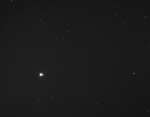 Earth and Moon from MESSENGER
1.09.2010
What does Earth look like from the planet Mercury? The robotic spacecraft MESSENGER found out as it looked toward the Earth during its closest approach to the Sun about three months ago. The Earth and Moon are visible as the double spot on the lower left of the above image.
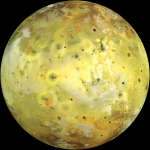 Io in True Color
30.03.2014
The strangest moon in the Solar System is bright yellow. This picture, an attempt to show how Io would appear in the "true colors" perceptible to the average human eye, was taken in 1999 July by the Galileo spacecraft that orbited Jupiter from 1995 to 2003.
 Retrograde Mars
27.10.2014
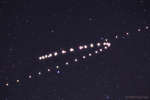
Why would Mars appear to move backwards? Most of the time, the apparent motion of Mars in Earth's sky is in one direction, slow but steady in front of the far distant stars. About every two years, however, the Earth passes Mars as they orbit around the Sun.
 A Black Hole Disrupts a Passing Star
24.03.2020
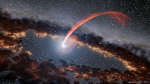
What happens to a star that goes near a black hole? If the star directly impacts a massive black hole, then the star falls in completely -- and everything vanishes. More likely, though, the star...
 Moonrays of August
4.08.2023
A Full Moon rose as the Sun set on August 1. Near perigee, the closest point in its almost moonthly orbit, the brighter than average lunar disk illuminated night skies around planet Earth as the second supermoon of 2023.
 APOD: 2025 September 5 Б 47 Tucanae: Globular Star Cluster
5.09.2025
Also known as NGC 104, 47 Tucanae is a jewel of the southern sky. Not a star but a dense cluster of stars, it roams the halo of our Milky Way Galaxy along with some 200 other globular star clusters.
 APOD: 2026 January 20 Б Io in True Color
20.01.2026
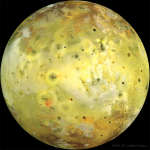
The strangest moon in the Solar System is bright yellow. The featured picture, an attempt to show how Io would appear in the "true colors" perceptible to the average human eye, was taken in 1999 July by the Galileo spacecraft that orbited Jupiter from 1995 to 2003.
 The Galactic Center in Infrared
8.07.2001
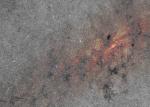
The center of our Galaxy is a busy place. In visible light, much of the Galactic Center is obscured by opaque dust. In infrared light, however, dust glows more and obscures less, allowing nearly one million stars to be recorded in the above photograph.
|
January February March April May June July August September |
|||||||||||||||||||||||||||||||||||||||||||||||||