
|
You entered: surface
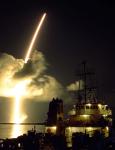 Cassini To Venus
16.10.1997
NASA's Saturn Explorer Cassini with ESA's Titan Probe Huygens attached successfully rocketed into the skies early yesterday morning. The mighty Titan 4B Centaur rocket is seen here across the water gracefully arcing away from Launch Complex 40 at Cape Canaveral Air Station.
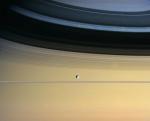 A Year at Saturn
31.12.2005
Arriving at Saturn in July of 2004, the Cassini spacecraft has now spent a year and a half exploring the magnificent rings and moons of the distant gas giant. The year 2005 began with Cassini's Huygens probe landing on Saturn's large moon Titan.
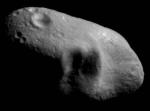 NEAR Shoemaker Views Eros
16.03.2000
Orbiting asteroid 433 Eros, 145 million miles from Earth, NASA's NEAR spacecraft has been returning stunning views as its year long mission of exploration gets underway. A mosaic of recent NEAR images recorded...
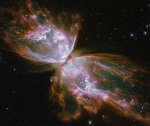 The Butterfly Nebula from Hubble
13.11.2011
Few butterflies have a wingspan this big. The bright clusters and nebulae of planet Earth's night sky are often named for flowers or insects, and NGC 6302 is no exception. With an estimated...
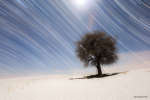 Star Trails of the North and South
12.02.2020
What divides the north from the south? It all has to do with the spin of the Earth. On Earth's surface, the equator is the dividing line, but on Earth's sky, the dividing line is the Celestial Equator -- the equator's projection onto the sky.
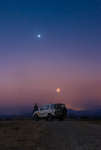 Love and War by Moonlight
16.07.2021
Venus, named for the Roman goddess of love, and Mars, the war god's namesake, come together by moonlight in this serene skyview, recorded on July 11 from Lualaba province, Democratic Republic of Congo, planet Earth.
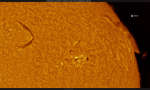 Filaprom on the Western Limb
24.06.2022
A solar filament is an enormous stream of incandescent plasma suspended above the active surface of the Sun by looping magnetic fields. Seen against the solar disk it looks dark only because it's a little cooler, and so slightly dimmer, than the solar photosphere.
 APOD: 2023 July 17 Б Shells and Arcs around Star CW Leonis
17.07.2023
What's happening around this star? No one is sure. CW Leonis is the closest carbon star, a star that appears orange because of atmospheric carbon dispersed from interior nuclear fusion. But CW Leonis also appears engulfed in a gaseous carbon-rich nebula.
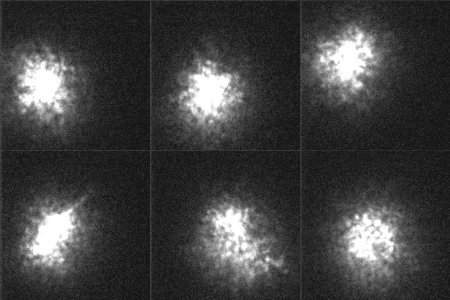 Why Stars Twinkle
25.07.2000
This is what a star really looks like from the surface of the Earth. To the best the human eye can see, stars are so far away they appear the same as would infinitesimal points of light.
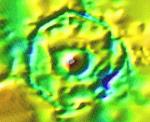 Mjølnir: Impact Crater
10.06.1999
The stark surface of Earth's moon is pocked with large craters, records of a history of fierce bombardment by the solar system's formative debris. It may be difficult to imagine, but nearby planet Earth itself has endured a similar cosmic pounding, though oceans, weathering, and geological
|
January February March April May June July August September October |
|||||||||||||||||||||||||||||||||||||||||||||||||