
|
You entered: surface
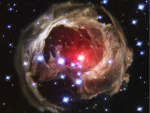 Light Echoes from V838 Mon
3.02.2008
What caused this outburst of V838 Mon? For reasons unknown, star V838 Mon's outer surface suddenly greatly expanded with the result that it became the brightest star in the entire Milky Way Galaxy in January 2002. Then, just as suddenly, it faded.
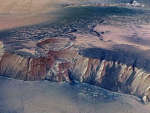 High Cliffs Surrounding Echus Chasma on Mars
23.07.2008
What created this great cliff on Mars? Did giant waterfalls once plummet through its grooves? With a four-kilometer drop, this high cliff surrounding Echus Chasma, near an impressive impact crater, was carved by either water or lava.
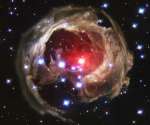 Light Echoes from V838 Mon
22.11.2009
What caused this outburst of V838 Mon? For reasons unknown, star V838 Mon's outer surface suddenly greatly expanded with the result that it became the brightest star in the entire Milky Way Galaxy in January 2002. Then, just as suddenly, it faded.
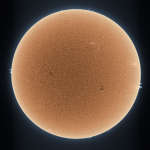 Orange Sun Simmering
9.06.2010
Even a quiet Sun can be a busy place. And over the deep Solar Minimum of the past few years, our Sun has been unusually quiet. The above image, taken last week...
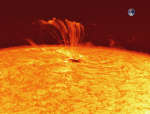 Violent Sunspot Group AR 1302 Unleashes a Flare
28.09.2011
One of the most active sunspot groups in years is currently crossing the Sun. AR 1302 first came around the Sun's edge last week and is so large it can be seen without a telescope.
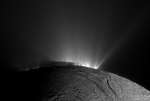 Shadows and Plumes Across Enceladus
4.08.2014
Why does Enceladus have ice plumes? The discovery of jets spewing water vapor and ice was detected by the Saturn-orbiting Cassini spacecraft in 2005. The origin of the water feeding the jets, however, remained a topic of research.
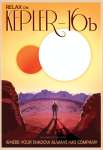 Where Your Shadow Has Company
20.02.2016
Want to take a relaxing interstellar vacation? Consider visiting Kepler-16b, a world in a binary star system. In fact Kepler-16b is the first discovered circumbinary planet. It was detected in a wide 229 day orbit around a close pair of cool, low-mass stars some 200 light-years away.
 The Day After Mars
1.11.2019
October 31, 1938 was the day after Martians encountered planet Earth, and everything was calm. Reports of the invasion were revealed to be part of a Halloween radio drama, the now famous broadcast based on H.G. Wells' scifi novel War of the Worlds.
 Iron in the Butterfly Nebula
21.07.2020
Can stars, like caterpillars, transform themselves into butterflies? No, but in the case of the Butterfly Nebula -- it sure looks like it. Though its wingspan covers over 3 light-years and its estimated surface temperature...
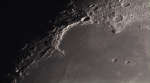 The Bay of Rainbows
12.02.2026
Dark, smooth regions that cover the Moon's familiar face are called by Latin names for oceans and seas. That naming convention is historical, though it may seem a little ironic to denizens...
|
January February March April May June July August September October |
|||||||||||||||||||||||||||||||||||||||||||||||||