
|
You entered: surface
 Small Moon Deimos
6.09.2024
Mars has two tiny moons, Phobos and Deimos, named for the figures in Greek mythology Fear and Panic. Detailed surface views of smaller moon Deimos are shown in both these panels. The images were taken in 2009, by the HiRISE camera on board the Mars Reconnaissance Orbiter spacecraft, NASA's long-lived interplanetary internet satellite.
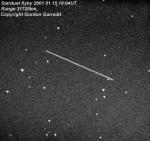 Sail On Stardust
24.01.2001
Spacecraft on long interplanetary voyages often use the planets themselves as gravitational "sling shots" to boost them along their way. Launched in February of 1999 on a historic voyage to a comet, the Stardust spacecraft is no different.
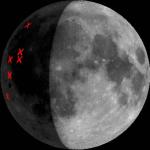 Moon Struck
7.12.2001
Craters produced by ancient impacts on the airless Moon have long been a familiar sight. But only since 1999 have observers seen elusive optical flashes on the lunar surface - likely explosions resulting from impacting meteoroids. These startling observations were made with modest telescopes and video equipment during the 1999 and 2001 Leonid meteor showers.
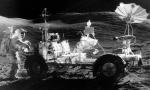 Apollo 17's Lunar Rover
1.07.1999
In December of 1972, Apollo 17 astronauts Eugene Cernan and Harrison Schmitt spent about 75 hours exploring the Moon's Taurus-Littrow valley while colleague Ronald Evans orbited overhead. Cernan and Schmitt were the last humans to walk or ride on the Moon - aided in their explorations by a Lunar Roving Vehicle.
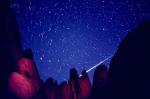 Polaris: The North Star
6.10.1999
Polaris is quite an unusual star. First, Polaris is the nearest bright star to the north spin axis of the Earth. Therefore, as the Earth turns, stars appear to rotate around Polaris, making it the North Star.
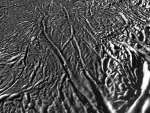 Close Up of Enceladus Tiger Stripes
31.03.2008
Could life exist beneath Enceladus? A recent flyby of Saturn's icy moon has bolstered this fascinating idea. Two years ago, images from the robotic Cassini spacecraft orbiting Saturn led astronomers to the undeniable...
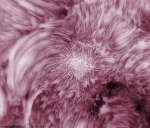 Fibrils Flower on the Sun
16.02.2015
When does the Sun look like a flower? In a specific color of red light emitted by hydrogen, as featured here, some regions of the solar chromosphere may resemble a rose. The color-inverted image was taken in 2014 October and shows active solar region 2177.
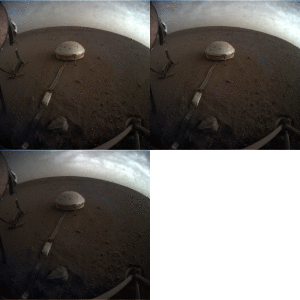 InSight on a Cloudy Day
3.10.2019
Clouds drift through the sky as the light fades near sunset in this three frame animated gif. The scene was captured on sol 145 beginning around 6:30pm local time by a camera on the Mars InSight lander. Of course, InSight's martian day, sol 145, corresponds to Earth calendar date April 25, 2019.
 APOD: 2024 April 17 Б Total Eclipse and Comets
16.04.2024
Not one, but two comets appeared near the Sun during last week's total solar eclipse. The expected comet was Comet 12P/Pons-Brooks, but it was disappointingly dimmer than many had hoped. However, relatively unknown Comet SOHO-5008 also appeared in long duration camera exposures.
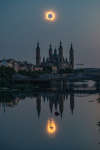 APOD: 2026 August 13 Б Total Solar Eclipse Over Spain
12.08.2026
On August 12th, 2026, the Moon totally eclipsed the Sun and cast its shadow across Siberia, Greenland, Iceland, Spain, and Portugal. TodayБs image features two total solar eclipses viewed from Zaragoza, Spain, one over the Cathedral-Basilica of Our Lady of the Pillar and the other reflecting in the Ebro River.
|
January February March April May June July August September October |
|||||||||||||||||||||||||||||||||||||||||||||||||