
|
You entered: nearby
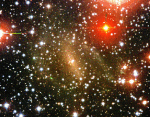 Galaxy Dwingeloo 1 Emerges
2.08.1998
Sometimes you can't see the forest for the trees. But if you look closely at the center of the above photograph, you will see a whole spiral galaxy behind the field of stars.
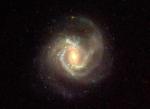 M61: Virgo Spiral Galaxy
22.09.1998
M61 is a barred spiral galaxy located in the nearby Virgo Cluster of Galaxies. Visible in M61 are a host of features common to spiral galaxies: bright spiral arms, a central bar, dust lanes, and bright knots of stars. M61, also known as NGC 4303, in similar to our own Milky Way Galaxy.
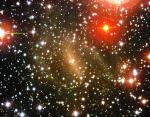 Galaxy Dwingeloo 1 Emerges
9.01.2000
Sometimes you can't see the forest for the trees. But if you look closely at the center of the above photograph, you will see a whole spiral galaxy behind the field of stars.
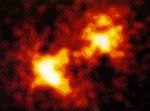 An X-ray Hot Supernova in M81
3.12.1995
In 1993, a star in the galaxy M81 exploded. Above is a picture of the hot material ejected by this supernova explosion. The picture was taken in X-rays with the Advanced Satellite for Cosmology and Astrophysics (ASCA).
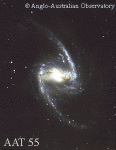 Barred Spiral Galaxy NGC 1365
19.05.1997
Many spiral galaxies have bars across their centers. Even our own Milky Way Galaxy is thought to have a bar, but perhaps not so prominent as the one in NGC 1365, shown above. The persistence and motion of the bar imply relatively massive spiral arms.
 Wanderers
29.04.2018
How far out will humanity explore? If this video's fusion of real space imagery and fictional space visualizations is on the right track, then at least the Solar System. Some of the video...
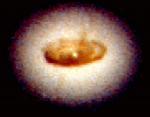 The Heart Of NGC 4261
19.10.1997
What evil lurks in the hearts of galaxies? This Hubble Space Telescope picture of the center of the nearby elliptical galaxy NGC 4261 tells one dramatic tale. The gas and dust in this disk are swirling into what is almost certainly a massive black hole.
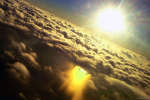 Inverted City Beneath Clouds
7.11.2016
How could that city be upside-down? The city, Chicago, was actually perfectly right-side up. The long shadows it projected onto nearby Lake Michigan near sunset, however, when seen in reflection, made the buildings appear inverted.
 Inverted City Beneath Clouds
24.06.2020
How could that city be upside-down? The city, Chicago, was actually perfectly right-side up. The long shadows it projected onto nearby Lake Michigan near sunset, however, when seen in reflection, made the buildings appear inverted.
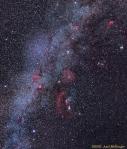 Clusters and Nebulae of the Hexagon
4.04.2003
At first, the bright stars of the large asterism known as the (northern) Winter Hexagon might be hard to pick out in this gorgeous deep sky mosaic from December 2002. But placing your cursor...
|
January February March April May June July August September |
|||||||||||||||||||||||||||||||||||||||||||||||||