
|
You entered: nearby
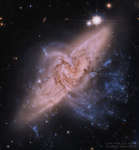 NGC 3314: When Galaxies Overlap
17.11.2021
Why doesn't the nearby galaxy create a gravitational lensing effect on the background galaxy? It does, but since both galaxies are so nearby, the angular shift is much smaller than the angular sizes of the galaxies themselves.
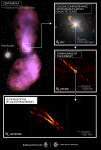 EHT Resolves Central Jet from Black Hole in Cen A
4.08.2021
How do supermassive black holes create powerful jets? To help find out, the Event Horizon Telescope (EHT) imaged the center of the nearby active galaxy Centaurus A. The cascade of featured inset images shows...
 APOD: 2023 July 5 Б A Map of the Observable Universe
5.07.2023
What if you could see out to the edge of the observable universe? You would see galaxies, galaxies, galaxies, and then, well, quasars, which are the bright centers of distant galaxies. To expand understanding...
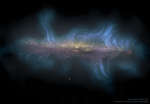 The Vertical Magnetic Field of NGC 5775
27.01.2021
How far do magnetic fields extend up and out of spiral galaxies? For decades astronomers knew only that some spiral galaxies had magnetic fields. However, after NRAO's Very Large Array (VLA) radio telescope...
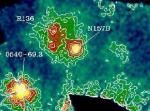 Ultra Fast Pulsar
11.02.1998
Pulsars are rotating neutron stars, born in the violent crucibles of supernova explosions. Like cosmic lighthouses, beams of radiation from surface hotspots sweep past our viewpoint creating pulses which reveal the rotation rates of these incredibly dense stellar corpses. The most famous pulsar of all is found in the nearby supernova remnant, the Crab Nebula.
 A Distant Cluster of Galaxies
7.12.1997
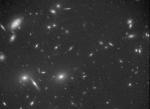
In this 1994 Hubble Space Telescope photograph, every bright object is a galaxy. Oddly - most of them are spiral galaxies. This rich cluster of galaxies, named CL 0939+4713, is almost half way across the visible universe.
 The Densest Galaxy
4.10.2013
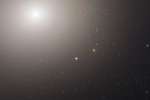
The bright core and outer reaches of giant elliptical galaxy M60 (NGC 4649) loom large at the upper left of this sharp close-up from the Hubble Space Telescope. Some 54 million light-years away and 120,000 light-years across, M60 is one of the largest galaxies in the nearby Virgo Cluster.
 A Distant Cluster of Galaxies
14.01.1996
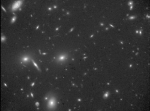
Every bright object in this 1994 photograph by the Hubble Space Telescope is a galaxy. Oddly - most of the objects are spiral galaxies. This rich cluster of galaxies, named CL 0939+4713, is almost half way across the visible universe.
 Echoes of Supernova 1987A
23.10.1997
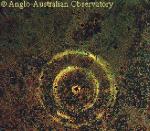
Can you find Supernova 1987a? It's not hard - it occurred in the center of the bulls-eye pattern. Although this stellar detonation was seen more than a decade ago, light from it continues to bounce off nearby interstellar dust and be reflected to us. These two rings are thus echoes of the powerful supernova.
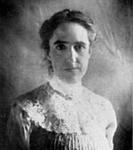 Henrietta Leavitt Calibrates the Stars
3.09.2000
Humanity's understanding of the relative brightness and variability of stars was revolutionized by the work of Henrietta Swan Leavitt (1868-1921). Working at Harvard College Observatory, Leavitt precisely calibrated the photographic magnitudes of 47 stars to which all other stars could be compared.
|
January February March April May June July August |
||||||||||||||||||||||||||||||||||||||||||||||||||||||||