
|
You entered: nearby
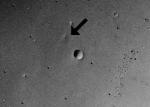 Mars Pathfinder's Landing Site
24.07.1997
Where is Mars Pathfinder? Follow the arrow in the above picture taken by the Viking Orbiter in 1976. From the surface Mars appears covered with rocks, but from orbit Mars appears covered with craters. However, several familiar features are visible in this photograph.
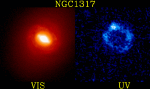 Starburst Ring in Galaxy NGC 1317
11.12.1996
Where do stars form? A typical place is an area of dense nebular gas common to arms in spiral galaxies. Sometimes, however, a burst of star formation can occur with unusual geometry. Nearby galaxy NGC 1317 shows such an unusual ring of star formation surrounding its barred nucleus.
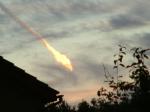 A Daytime Fireball Over South Wales
1.10.2003
Jon Burnett, a teenager from South Wales, UK, was photographing some friends skateboarding last week when the sky did something very strange. High in the distance, a sofa-sized rock came hurtling into the nearby atmosphere of planet Earth and disintegrated.
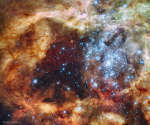 Star Cluster R136 Breaks Out
10.01.2021
In the center of nearby star-forming region lies a huge cluster containing some of the largest, hottest, and most massive stars known. These stars, known collectively as star cluster R136, part of the Tarantula Nebula, were captured in the featured image in visible light in 2009 through the Hubble Space Telescope.
 APOD: 2024 March 27 Б The Coma Cluster of Galaxies
27.03.2024
Almost every object in the featured photograph is a galaxy. The Coma Cluster of Galaxies pictured here is one of the densest clusters known - it contains thousands of galaxies. Each of these galaxies houses billions of stars - just as our own Milky Way Galaxy does.
 Observatory, Mountains, Universe
29.12.2014
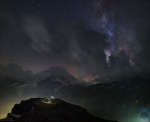
The awesomeness in this image comes in layers. The closest layer, in the foreground, contains the Peak Terskol Observatory located in the northern Caucasus Mountains of Russia. The white dome over the 2-meter telescope is clearly visible. The observatory is located on a shoulder of Mt.
 A Star Where Photons Orbit
4.01.1997
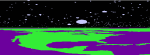
The above computer animated picture depicts how a very compact star would look to a nearby observer. The star pictured is actually more compact that any known except a black hole, so it is only hypothetical. The observer is situated at the photon sphere, where photons can orbit in a circle.
 Hot Stars in the Southern Milky Way
7.05.1999
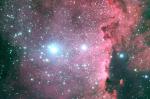
Hot blue stars, red glowing hydrogen gas, and dark, obscuring dust clouds are strewn through this dramatic region of the Milky Way in the southern constellation of Ara (the Altar). About 4,000 light-years from Earth, the stars at the left are young, massive, and energetic.
 Hot Stars in the Southern Milky Way
22.12.2001
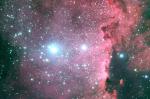
Hot blue stars, red glowing hydrogen gas, and dark, obscuring dust clouds are strewn through this dramatic region of the Milky Way in the southern constellation of Ara (the Altar). About 4,000 light-years from Earth, the stars at the left are young, massive, and energetic.
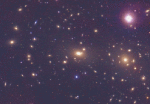 The Coma Cluster of Galaxies
13.12.1997
Almost every object in the above photograph is a galaxy. The Coma Cluster of Galaxies pictured is one of the densest clusters known - it contains thousands of galaxies. Each of these galaxies house billions of stars - just as our own Milky Way Galaxy does.
|
January February March April May June July August September |
|||||||||||||||||||||||||||||||||||||||||||||||||