
|
You entered: dark
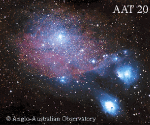 Nebulosity in Sagittarius
18.07.1996
What causes the colors in this beautiful nebulosity in Sagittarius? Dubbed NGC 6589 and NGC 6590, the colors of this nebulosity, are caused by gas and dust. The blue color of the nebula nearest the bright stars is caused by reflection off interstellar dust.
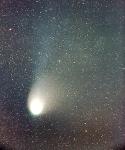 Comet Hale-Bopp Returns
6.02.1997
Comet Hale-Bopp has returned from behind the Sun. In December and early January, Comet Hale-Bopp was too near the Sun to be easily visible from Earth. Now the comet graces the morning sky and is visible from dark locations even without binoculars.
 An Antarctic Total Solar Eclipse
4.05.2008
The Sun, the Moon, Antarctica, and two photographers all lined up in 2003 Antarctica during an unusual total eclipse of the Sun. Even given the extreme location, a group of enthusiastic eclipse chasers ventured near the bottom of the world to experience the surreal momentary disappearance of the Sun behind the Moon.
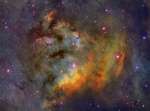 Sharpless 171
18.10.2008
Cosmic pillars of cold molecular gas and clouds of dark dust lie within Sharpless 171, a star-forming region some 3,000 light-years away in the royal constellation Cepheus. This tantalizing false-color skyscape spans about 20 light-years across the nebula's bright central region.
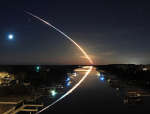 Waterway to Orbit
13.02.2010
The 32nd shuttle mission to the International Space Station, STS-130, left planet Earth on February 8. Its early morning launch to orbit from Kennedy Space Center's pad 39A followed the long, graceful, eastward arc seen in this 2 minute time exposure.
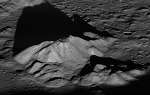 Sunrise at Tycho
6.07.2011
Tycho crater's central peak complex casts a long, dark shadow near local sunrise in this spectacular lunarscape. The dramatic oblique view was recorded on June 10 by the Lunar Reconnaissance Orbiter. Shown in amazing detail, boulder strewn slopes and jagged shadows appear in the highest resolution version at 1.5 meters per pixel.
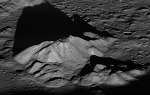 Sunrise at Tycho
4.01.2013
Tycho crater's central peak complex casts a long, dark shadow near local sunrise in this spectacular lunarscape. The dramatic oblique view was recorded on June 10, 2011 by the Lunar Reconnaissance Orbiter. Shown in amazing detail, boulder strewn slopes and jagged shadows appear in the highest resolution version at 1.5 meters per pixel.
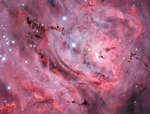 The Deep Lagoon
29.07.2015
Ridges of glowing interstellar gas and dark dust clouds inhabit the turbulent, cosmic depths of the Lagoon Nebula. Also known as M8, The bright star forming region is about 5,000 light-years distant.
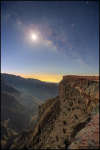 Milky Way in Moonlight
23.04.2016
A waning crescent moon, early morning twilight, and Al Hamra's city lights on the horizon can't hide the central Milky Way in this skyscape from planet Earth. Captured in a single exposure...
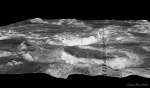 Cylindrical Mountains on Venus
16.10.2016
What could cause a huge cylindrical mountain to rise from the surface of Venus? Such features that occur on Venus are known as coronas. Pictured here in the foreground is 500-kilometer wide Atete Corona found in a region of Venus known as the Galindo.
|
January February March April May June July August September |
|||||||||||||||||||||||||||||||||||||||||||||||||