
|
You entered: dark
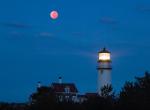 Eclipse with Lighthouse
10.03.2007
A red Moon rose over Cape Cod, Massachusetts, USA on March 3rd, immersed in Earth's shadow near the total phase of a lunar eclipse. This serene portrait of the eclipsed Moon in a dark blue twilight sky also features the Highland Lighthouse (aka Cape Cod lighthouse), another more locally familiar beacon in the night.
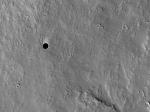 A Hole in Mars
28.05.2007
Black spots have been discovered on Mars that are so dark that nothing inside can be seen. Quite possibly, the spots are entrances to deep underground caves capable of protecting Martian life, where it to exist. The unusual hole pictured above was found on the slopes of the giant Martian volcano Arsia Mons.
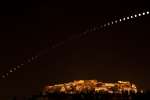 Eclipse over the Acropolis
25.06.2011
The total phase of the June 15 lunar eclipse lasted an impressive 100 minutes. Its entire duration is covered in this composite of a regular sequence of digital camera exposures, tracking the dark lunar disk as it arced above the Acropolis in Athens, Greece.
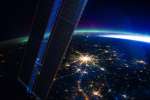 Yuri s Planet
12.04.2012
On another April 12th, in 1961, Soviet cosmonaut Yuri Alexseyevich Gagarin became the first human to see planet Earth from space. Commenting on his view from orbit he reported, "The sky is very dark; the Earth is bluish. Everything is seen very clearly". To celebrate, consider this recent image from the orbiting International Space Station.
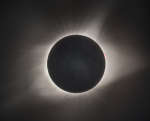 The Crown of the Sun
23.08.2017
During a total solar eclipse, the Sun's extensive outer atmosphere, or corona, is an inspirational sight. Streamers and shimmering features visible to the eye span a brightness range of over 10,000 to 1, making them notoriously difficult to capture in a single photograph.
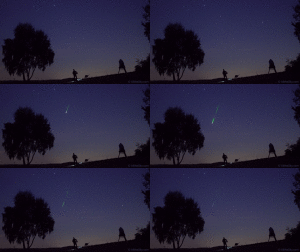 Real Time Perseid
8.09.2018
Bright meteors and dark night skies made this year's Perseid meteor shower a great time for a weekend campout. And while packing away their equipment, skygazers at a campsite in the mountains...
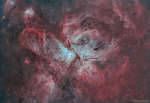 The Great Nebula in Carina
7.05.2019
What's happening in the center of the Carina Nebula? Stars are forming, dying, and leaving an impressive tapestry of dark dusty filaments. The entire Carina Nebula, cataloged as NGC 3372, spans over 300 light years and lies about 8,500 light-years away in the constellation of Carina.
 APOD: 2024 March 24 Б Looking Back at an Eclipsed Earth
24.03.2024
Here is what the Earth looks like during a solar eclipse. The shadow of the Moon can be seen darkening part of Earth. This shadow moved across the Earth at nearly 2000 kilometers per hour.
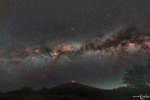 Mount Etna Milky Way
5.07.2024
A glow from the summit of Mount Etna, famous active stratovolcano of planet Earth, stands out along the horizon in this mountain and night skyscape. Bands of diffuse light from congeries of innumerable stars along the Milky Way galaxy stretch across the sky above.
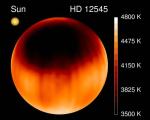 A Giant Starspot on HD 12545
12.07.2000
What could cause a star to have such a large spot? Our Sun itself frequently has sunspots, relatively cool dark magnetic depressions that move across its surface. HD 12545, however, exhibits the largest starspots yet observed.
|
January February March April May June July August September |
|||||||||||||||||||||||||||||||||||||||||||||||||