
|
You entered: dark
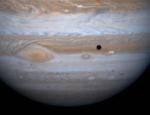 Jupiter, Io, and Shadow
7.12.2002
Pictured above is the innermost of Jupiter's Galilean satellites, Io, superposed in front of the gas giant planet. To the left of Io is a dark spot that is Io's own shadow. A solar eclipse would be seen from within the shadow spot on Jupiter.
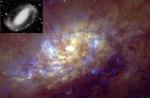 Starbirth in NGC 1808
23.03.1998
The center of galaxy NGC 1808 is bursting with new stars, but why? Being a barred spiral galaxy makes NGC 1808 somewhat similar to our own Milky Way Galaxy. But the disk of NGC 1808 (inset) is quite warped, and its center is unusually bright and blue.
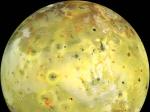 Io in True Color
2.05.2004
The strangest moon in the Solar System is bright yellow. This picture, showing Io's true colors, was taken in 1999 July by the Galileo spacecraft that orbited Jupiter from 1995 to 2003. Io's colors derive from sulfur and molten silicate rock.
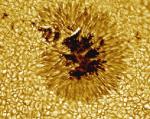 A Sunspot Up Close
5.10.1998
Sometimes, small regions of the Sun appear unusually dark. Visible above is a close-up picture of a sunspot, a depression on the Sun's face that is slightly cooler and less luminous than the rest of the Sun.
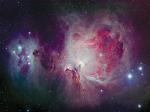 The Great Nebula in Orion
27.09.2004
The Great Nebula in Orion is a colorful place. Visible to the unaided eye, it appears as a small fuzzy patch in the constellation of Orion. Long exposure, digitally sharpened images like this, however, show the Orion Nebula to be a busy neighborhood of young stars, hot gas, and dark dust.
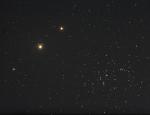 Planets, Bees, and a Donkey
22.06.2006
The heralded alignment of wandering planets Saturn and Mars with the well-known Beehive Cluster took place last weekend on Saturday, June 17. Recorded in dark Arizona skies on that date, this view finds Mars...
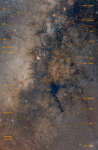 The Annotated Galactic Center
31.08.2010
The sky toward the center of our Galaxy is filled with a wide variety of celestial wonders, many of which are visible from a dark location with common binoculars. Constellations near the Galactic Center include Sagittarius, Libra, Scorpius, Scutum, and Ophiuchus.
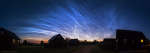 Veins of Heaven
31.07.2014
Transfusing sunlight through a a still dark sky, this exceptional display of noctilucent clouds was captured earlier this month above the island of Gotland, Sweden. From the edge of space, about 80 kilometers above...
 Eclipse at Moonrise
11.10.2014
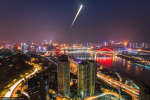
As the Moon rose and the Sun set on October 8, a lunar eclipse was in progress seen from Chongqing, China. Trailing through this composite time exposure, the rising Moon began as a dark reddened disk in total eclipse near the eastern horizon.
 NGC 3628: The Hamburger Galaxy
3.05.2017
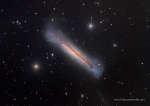
No, hamburgers are not this big. What is pictured is a sharp telescopic views of a magnificent edge-on spiral galaxy NGC 3628 show a puffy galactic disk divided by dark dust lanes. Of course, this deep galactic portrait puts some astronomers in mind of its popular moniker, The Hamburger Galaxy.
|
January February March April May June July August September |
|||||||||||||||||||||||||||||||||||||||||||||||||