
|
You entered: Voyager
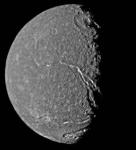 Titania's Trenches
11.01.1997
British astronomer Sir William Herschel discovered Titania and Oberon in 1787, 210 years ago today. He wasn't reading Shakespeare's A Midsummer Night's Dream though, he was making the first telescopic observations of moons of the planet Uranus (a planet which he himself discovered in 1781).
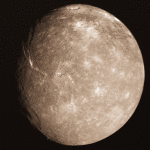 Uranus' Largest Moon: Titania
4.03.1996
Titania's tortured terrain is a mix of valleys and craters. NASA's interplanetary robot spacecraft Voyager 2 passed this moon of Uranus in 1986 and took the above photograph. The photograph was then transmitted back to earth by radio.
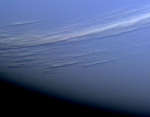 Two Hours Before Neptune
8.08.2010
Two hours before closest approach to Neptune in 1989, the Voyager 2 robot spacecraft snapped this picture. Clearly visible for the first time were long light-colored cirrus-type clouds floating high in Neptune's atmosphere. Shadows of these clouds can even be seen on lower cloud decks.
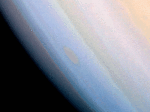 Saturn's Cloud Tops
17.03.1996
This close-up of the tops of Saturn's clouds was taken by the Voyager 1 robot spacecraft as it passed the giant planet in November 1980. Saturn's clouds are mostly composed of hydrogen and helium gas, but the small addition of other elements gives the clouds their colors.
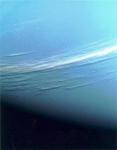 Two Hours Before Neptune
5.10.1999
Two hours before closest approach to Neptune in 1989, the Voyager 2 robot spacecraft snapped this picture. Clearly visible for the first time were long light-colored cirrus-type clouds floating high in Neptune's atmosphere. Shadows of these clouds can even be seen on lower cloud decks.
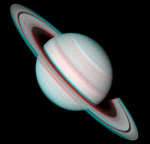 Stereo Saturn
29.10.1997
Get out your red/blue glasses and launch yourself into this stereo picture of Saturn! The picture is actually composed from two images recorded weeks apart by the Voyager 2 spacecraft during its visit to the Saturnian System in August of 1981.
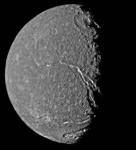 Titania's Trenches
30.09.2000
British astronomer Sir William Herschel discovered Titania and Oberon in January of 1787. He wasn't reading Shakespeare's A Midsummer Night's Dream though, he was making the first telescopic observations of moons of the planet Uranus (a planet which he himself discovered in 1781).
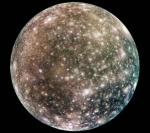 Callisto Full Face
20.01.2002
Callisto's surface shows its age. While probably formed at the same time as Io, the difference between the surfaces of these two moons of Jupiter could hardly be greater. Io's surface is young, shows practically no impact craters, and is continually being repaved by the lava exploding from its many large volcanoes
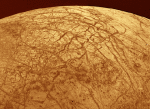 Europa's Surface
13.08.1996
Voyager spacecraft images of Europa's surface, like the one above, are suggestive of sea ice on Earth. The criss-crossing dark streaks may indeed be cracks in its ice-covered surface caused by Jupiter's tidal stresses accompanied by the freezing and expansion of an underlying layer of water.
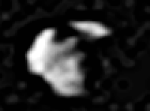 Dione's Lagrange Moon Helene
10.10.1995
Saturn's moon Helene is very unusual in that it circles Saturn near the orbit of a bigger moon: Dione. Helene is situated in what is called a "Lagrange point" of Dione - a place of stability created by Dione's gravity.
|
January February March April May June July August September October |
|||||||||||||||||||||||||||||||||||||||||||||||||