
|
You entered: Voyager
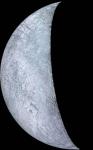 Crescent Europa
25.02.2002
Although the phase of this moon might appear familiar, the moon itself might not. In fact, this crescent shows part of Jupiter's moon Europa. The passing robot spacecraft Voyager 2 captured this image in 1979.
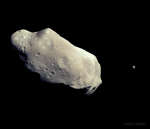 Ida and Dactyl: Asteroid and Moon
17.10.2025
This asteroid has a moon. The robot spacecraft Galileo enroute to explore the Jovian system in 1993, encountered and photographed two asteroids during its long interplanetary voyage. The second minor planet it photographed, 243 Ida, was discovered to have a moon.
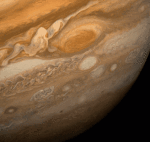 The Clouds of Jupiter
20.09.1997
What makes the colors in Jupiter's clouds? With a mean temperature of 120 degrees Kelvin (-153 degrees Celsius) and a composition dominated by hydrogen (about 90%), and helium (about 10%) with a smattering...
 Jupiter's Colorful Clouds
3.08.1996
What makes the colors in Jupiter's clouds? With a mean temperature of 120 degrees Kelvin (-153 degrees Celsius) and a composition dominated by Hydrogen (about 90%), and Helium (about 10%) with a smattering...
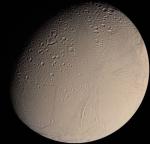 Ski Enceladus
24.01.2002
A small inner moon of Saturn, Enceladus is only about 500 kilometers in diameter. But the cold, distant world does reflect over 90 percent of the sunlight it receives, giving its surface about the same reflectivity as new-fallen snow.
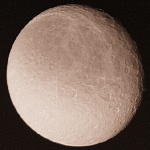 Rhea: Saturn's Second Largest Moon
14.10.1995
Rhea is the second largest moon of Saturn, behind Titan, and the largest without an atmosphere. It is composed mostly of water ice, but has a small rocky core. Rhea's rotation and orbit are locked together (just like Earth's Moon) so that one side always faces Saturn.
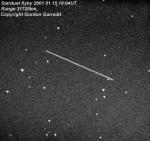 Sail On Stardust
25.01.2001
Spacecraft on long interplanetary voyages often use the planets themselves as gravitational "sling shots" to boost them along their way. Launched in February of 1999 on a historic voyage to a comet, the Stardust spacecraft is no different.
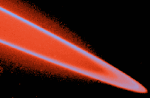 Jupiter's Rings
2.08.1995
Astronomers using NASA's Voyager spacecraft to search for a ring system around Jupiter discovered these faint rings in 1979. Unlike Saturn's bright rings which are composed of chunks of rock and ice, Jupiter's rings appear to consist of fine particles of dust.
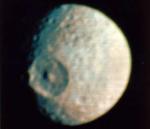 Mimas: Small Moon with a Big Crater
25.04.1999
Mimas is one of the smaller moons of Saturn but shows one of the largest impact craters. In fact, if the impact had been much greater, it would have disrupted the entire satellite. The large crater has been named Herschel after the 1789 discoverer of Mimas, Sir William Herschel.
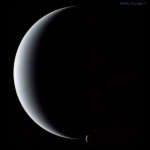 Crescent Neptune and Triton
25.07.2021
Gliding silently through the outer Solar System, the Voyager 2 spacecraft camera captured Neptune and Triton together in crescent phase. The elegant picture of the gas giant planet and its cloudy moon was taken from behind just after closest approach in 1989.
|
January February March April May June July August September October |
|||||||||||||||||||||||||||||||||||||||||||||||||