
|
You entered: distance
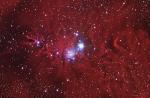 Fox Fur, the Unicorn, and a Christmas Tree
28.02.2003
Glowing hydrogen gas fills this gorgeously detailed sky view centered on the variable star S Mon in the faint but fanciful constellation Monoceros, the Unicorn. A star forming region (NGC 2264), the complex jumble...
 Eris: The Largest Known Dwarf Planet
18.09.2006
Is Pluto the largest dwarf planet? No! Currently, the largest known dwarf planet is (136199) Eris, renamed last week from 2003 UB313. Eris is just slightly larger than Pluto, but orbits as far as twice Pluto's distance from the Sun.
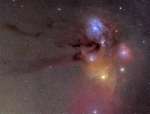 The Dark River to Antares
8.07.2009
Connecting the Pipe Nebula to the colorful regon near bright star Antares is a dark cloud dubbed the Dark River, flowing from the picture's left edge. Murky looking, the Dark River's appearance is caused by dust obscuring background starlight, although the dark nebula contains mostly hydrogen and molecular gas.
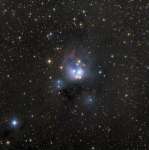 Young Suns of NGC 7129
4.09.2010
Young suns still lie within dusty NGC 7129, some 3,000 light-years away toward the royal constellation Cepheus. While these stars are at a relatively tender age, only a few million years old, it is likely that our own Sun formed in a similar stellar nursery some five billion years ago.
 In the Shadow of Saturn
4.09.2011
In the shadow of Saturn, unexpected wonders appear. The robotic Cassini spacecraft now orbiting Saturn drifted in giant planet's shadow for about 12 hours in 2006 and looked back toward the eclipsed Sun. Cassini saw a view unlike any other.
 Arp 272
22.09.2011
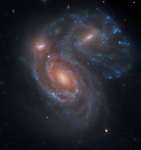
Linking spiral arms, two large colliding galaxies are featured in this remarkable cosmic portrait constructed using image data from the Hubble Legacy Archive. Recorded in astronomer Halton Arp's Atlas of Peculiar Galaxies as Arp 272, the pair is otherwise known as NGC 6050 near center, and IC 1179 at upper right.
 Kepler 78b: Earth Sized Planet Discovered
5.11.2013
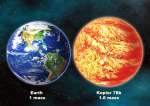
Even though Kepler-78b is only slightly larger than the Earth, it should not exist. Its size is extraordinary only in the sense that it is the most similar in size to the Earth of any exoplanet yet directly discovered.
 ISS Double Transit
12.09.2015
Not once, but twice the International Space Station transits the Sun on consecutive orbits of planet Earth in this video frame composite. The scene was captured on August 22 from a single well-chosen location in Schmalenbeck, Germany where the ISS created intersecting shadow paths only around 7 kilometers wide.
 Wide Field: Fox Fur, Unicorn, and Christmas Tree
10.03.2020
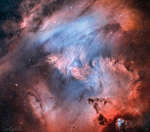
What do the following things have in common: a cone, the fur of a fox, and a Christmas tree? Answer: they all occur in the constellation of the unicorn (Monoceros). Pictured as a star...
 Pandora's Cluster of Galaxies
8.06.2024
This deep field mosaicked image presents a stunning view of galaxy cluster Abell 2744 recorded by the James Webb Space Telescope's NIRCam. Also dubbed Pandora's Cluster, Abell 2744 itself appears to be a ponderous merger of three different massive galaxy clusters. It lies some 3.5 billion light-years away, toward the constellation Sculptor.
|
January February March April May |
|||||||||||||||||||||||||||||||||||||||||||||||||