
|
You entered: distance
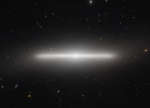 NGC 4452: An Extremely Thin Galaxy
9.11.2010
Why is there a line segment on the sky? In one of the more precise alignments known in the universe, what is pictured above is actually a disk galaxy being seen almost perfectly edge on. The image from the Hubble Space Telescope is a spectacular visual reminder of just how thin disk galaxies can be.
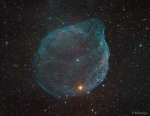 Sharpless 308: Star Bubble
23.06.2015
Blown by fast winds from a hot, massive star, this cosmic bubble is huge. Cataloged as Sharpless 2-308 it lies some 5,200 light-years away toward the constellation of the Big Dog (Canis Major) and covers slightly more of the sky than a Full Moon.
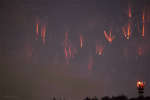 Red Sprite Lightning over the Czech Republic
12.09.2022
What are those red filaments in the sky? They are a rarely seen form of lightning confirmed only about 35 years ago: red sprites. Research has shown that following a powerful positive cloud-to-ground lightning...
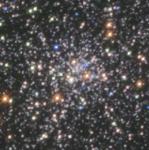 At The Core Of M15
17.01.1998
Densely packed stars in the core of the globular cluster M15 are shown in this Hubble Space Telescope (HST) image. The star colors roughly indicate their temperatures - hot stars appear blue, cooler stars look reddish-orange.
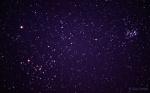 Saturn and Vesta in Taurus
18.01.2002
Last November, while skygazing toward the constellation Taurus, astrophotographer Joe Orman arranged this time exposure to include the lovely Hyades and Pleiades star clusters in the field of his telephoto lens. A distance...
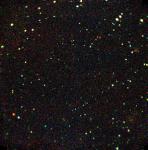 Chandra Deep Field
12.10.2002
Officially the Chandra Deep Field - South, this picture represents the deepest ever x-ray image of the Universe. One million seconds of accumulated exposure time with the orbiting Chandra X-ray Observatory went in to its making.
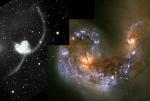 The Antennae Galaxies
22.10.1997
A ground-based telescopic view (left) of the collision between the galaxies NGC4038 and NGC4039 reveals long arcing insect-like "antennae" of luminous matter flung from the scene of the accident. Investigators using the Hubble Space...
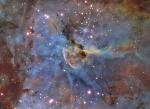 Eta and Keyhole in the Carina Nebula
16.03.2006
South is toward the top in this colorful close-up view of the Great Carina Nebula (NGC 3372), famous star-forming region of the southern sky. Covering an area surrounding the dusty Keyhole Nebula (NGC 3324)...
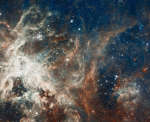 Star Formation in the Tarantula Nebula
16.05.2012
The largest, most violent star forming region known in the whole Local Group of galaxies lies in our neighboring galaxy the Large Magellanic Cloud (LMC). Were the Tarantula Nebula at the distance of the Orion Nebula -- a local star forming region -- it would take up fully half the sky.
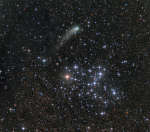 Messier 6 and Comet Siding Spring
17.10.2014
This looks like a near miss but the greenish coma and tail of Comet Siding Spring (C/2013 A1) are really 2,000 light-years or so away from the stars of open cluster Messier 6. They do appear close together though, along the same line-of-sight in this gorgeous October 9th skyscape toward the constellation Scorpius.
|
January February March April May |
|||||||||||||||||||||||||||||||||||||||||||||||||