
|
You entered: Observatory
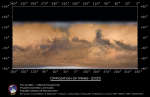 Global Map: Mars at Opposition
20.11.2020
This may be the best global Mars map made with a telescope based on planet Earth. The image data were captured by a team of observers over six long nights...
 Welcome to Perihelion
4.01.2025
Earth's orbit around the Sun is not a circle, it's an ellipse. The point along its elliptical orbit where our fair planet is closest to the Sun is called perihelion. This year perihelion is today, January 4, at 13:28 UTC, with the Earth about 147 million kilometers from the Sun.
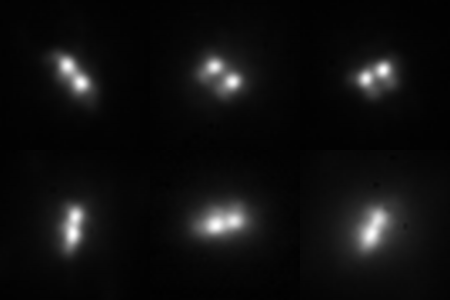 Double Asteroid 90 Antiope
1.11.2000
This eight-frame animation is based on the first ever images of a double asteroid! Formerly thought to be a single enormous chunk of rock, asteroid 90 Antiope resides in the solar system's main asteroid belt between Mars and Jupiter.
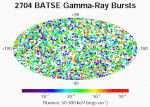 BATSE GRB Final Sky Map
28.06.2000
What causes the most powerful explosions in the universe? The BATSE modules that flew on the Compton Gamma Ray Observatory allowed more insight into enigmatic gamma-ray burst (GRB) explosions than ever before. From 1991-2000, BATSE detected 2704 GRBs, much more than ever previously recorded.
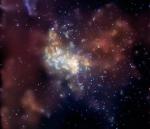 X-Rays from the Galactic Core
6.11.2004
Using the orbiting Chandra X-ray Observatory, astronomers have taken this long look at the core of our Milky Way galaxy, some 26,000 light-years away. The spectacular false-color view spans about 130 light-years.
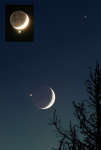 Venus in the Moon
4.12.2008
On December 1, bright planets Venus and Jupiter gathered near the young crescent Moon, an inspiring celestial scene in early evening skies around the world. But from some locations the Moon actually passed in front of Venus, interrupting the tight grouping with a lunar occultation.
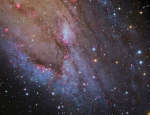 NGC 206 and the Star Clouds of Andromeda
25.09.2014
The large stellar association cataloged as NGC 206 is nestled within the dusty arms of the neighboring Andromeda galaxy. Also known as M31, the spiral galaxy is a mere 2.5 million light-years away.
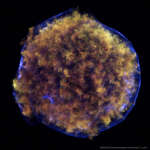 Tychos Supernova Remnant in Xray
13.01.2019
What star created this huge puffball? What's pictured is the hot expanding nebula of Tycho's supernova remnant, the result of a stellar explosion first recorded over 400 years ago by the famous astronomer Tycho Brahe. The featured image is a composite of three X-ray colors taken by the orbiting Chandra X-ray Observatory.
 APOD: 2025 September 13 Б Star Trails over One Mile Radio Telescope
13.09.2025
The steerable 60 foot diameter dish antenna of the One-Mile Telescope at Mullard Radio Astronomy Observatory, Cambridge, UK, is pointing skyward in this evocative night-skyscape. To capture the dramatic scene, consecutive 30 second exposures were recorded over a period of 90 minutes.
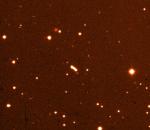 Asteroid 2002 NY40
17.08.2002
Asteroid 2002 NY40 will fly by planet Earth early in the morning August 18 Universal Time (late in the evening August 17 Eastern Daylight Time). Approaching to within about 530,000 kilometers or 1.3 times the Earth-Moon distance 2002 NY40 will definitely not be close enough to pose any danger of collision.
|
January February March April May June July August September October |
|||||||||||||||||||||||||||||||||||||||||||||||||