
|
You entered: Observatory
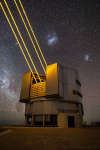 Firing Lasers to Tame the Sky
10.02.2021
Why do stars twinkle? Our atmosphere is to blame as pockets of slightly off-temperature air, in constant motion, distort the light paths from distant astronomical objects. Atmospheric turbulence is a problem for astronomers because it blurs the images of the sources they want to study.
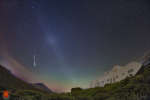 A Meteor and the Gegenschein
12.05.2021
Is the night sky darkest in the direction opposite the Sun? No. In fact, a rarely discernable faint glow known as the gegenschein (German for "counter glow") can be seen 180 degrees around from the Sun in an extremely dark sky. The gegenschein is sunlight back-scattered off small interplanetary dust particles.
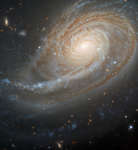 Arp 78: Peculiar Galaxy in Aries
24.03.2022
Peculiar spiral galaxy Arp 78 is found within the boundaries of the head strong constellation Aries. Some 100 million light-years beyond the stars and nebulae of our Milky Way galaxy, the island universe is over 100,000 light-years across.
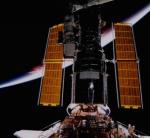 Hubble Holiday
24.12.1999
How would you like to spend your holiday in low earth orbit? That's what the crew of the space shuttle Discovery is doing as they deliver six new gyros and a faster main computer to the orbiting Hubble Space Telescope.
 X Rays from M17
21.08.2003
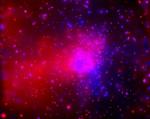
About 5,000 light-years away, toward the constellation Sagittarius and the center of our galaxy, lies the bright star forming region cataloged as M17. In visible light, M17's bowed and hollowed-out appearance has resulted in many popular names like the Horseshoe, Swan, Omega, and Lobster nebula. But what has sculpted this glowing gas cloud?
 GRB 980703: A Reassuring Redshift
13.07.1998
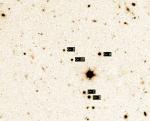
In the old days, just over a year ago, astronomers had little idea of the true distance to gamma-ray bursts. Did these enigmatic explosions occur in our outer Galaxy, or in the outer Universe?
 M27: Not A Comet
23.10.1999
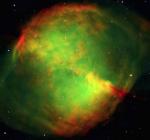
While searching the skies above 18th century France for comets, astronomer Charles Messier diligently recorded this object as number 27 on his list of things which are definitely not comets. So what is it?
 Black Holes in Merging Galaxies
29.05.2010
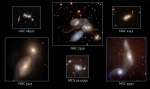
Violent galaxy mergers can feed supermassive black holes. Theoretically, the result is intense emission from regions near the supermassive black holes, creating the some of the most luminous objects in the universe. Astronomers dub these Active Galactic Nuclei, or just AGN.
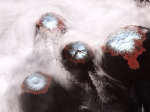 Islands of Four Mountains from Above
22.06.2010
Our Earth is covered by volcanoes. Volcanoes are breaks in the Earth's cool surface where hot liquid rock from the interior comes out -- sometimes suddenly. In the above image from the ASTER camera...
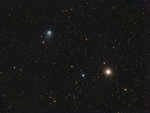 Comet Garradd and Messier 15
6.08.2011
Recorded on August 2, this telescopic composite image catches Comet Garradd (C/2009 P1) in the same field of view as globular star cluster M15. The celestial scene would have been a rewarding one for influential 18th century comet hunter Charles Messier.
|
January February March April May June July August September October |
|||||||||||||||||||||||||||||||||||||||||||||||||