
|
You entered: Observatory
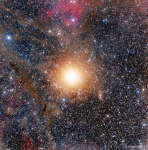 Behind Betelgeuse
10.05.2020
What's behind Betelgeuse? One of the brighter and more unusual stars in the sky, the red supergiant star Betelgeuse can be found in the direction of famous constellation Orion. Betelgeuse, however, is actually...
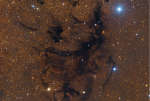 LDN 673: Dark Clouds in Aquila
28.10.2022
Part of a dark expanse that splits the crowded plane of our Milky Way galaxy, the Aquila Rift arcs through planet Earth's skies near bright star Altair. In eerie silhouette against the Milky...
 APOD: 2023 July 11 Б Sunspots on an Active Sun
10.07.2023
Why is our Sun so active now? No one is sure. An increase in surface activity was expected because our Sun is approaching solar maximum in 2025. However, last month our Sun sprouted more sunspots than in any month during the entire previous 11-year solar cycle -- and even dating back to 2002.
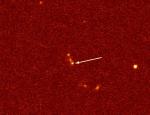 Gamma Ray Burst Afterglow: Supernova Connection
5.04.2002
What causes the mysterious gamma-ray bursts? Indicated in this Hubble Space Telescope exposure of an otherwise unremarkable field in the constellation Crater, is the dwindling optical afterglow of a gamma-ray burst first detected by the Beppo-SAX satellite on 2001 December 11.
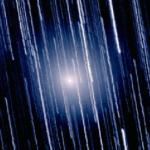 Tempel Tuttle: The Leonid Comet
15.11.2002
Star trails streak this composite time exposure of comet Tempel-Tuttle recorded by Tim Puckett on January 26, 1998. Then passing through the inner solar system on its 33 year orbit around the Sun, Tempel-Tuttle brightened unexpectedly, but binoculars or small telescopes were still required to visually observe it.
 Star Wars in NGC 664
24.02.1997
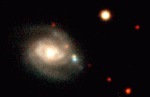
Long ago in a galaxy far, far away, locked in their final desperate struggle against the force of gravity ... two stars exploded! Stellar explosions - Supernovae - are among the most powerful events in the Universe, estimated to release an equivalent energy of up to 1 million trillion trillion (1 followed by 30 zeros) megatons of TNT.
 Star Wars in NGC 664
18.04.1998
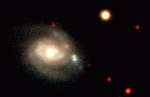
Long ago in a galaxy far, far away, locked in their final desperate struggle against the force of gravity ... two stars exploded! stellar explosions - Supernovae - are among the most powerful events in the Universe, estimated to release an equivalent energy of up to 1 million trillion trillion (1 followed by 30 zeros) megatons of TNT.
 Star Wars in NGC 664
15.05.1999
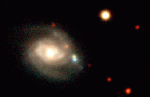
Long ago in a galaxy far, far away, locked in their final desperate struggle against the force of gravity ... two stars exploded! stellar explosions - Supernovae - are among the most powerful events in the Universe, estimated to release an equivalent energy of up to 1 million trillion trillion (1 followed by 30 zeros) megatons of TNT.
 Herschel s Cygnus X
17.05.2012
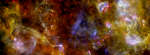
The Herschel Space Observatory's infrared view of Cygnus X spans some 6x2 degrees across one of the closest, massive star forming regions in the plane of our Milky Way galaxy. In fact, the rich stellar nursery already holds the massive star cluster known as the Cygnus OB2 association.
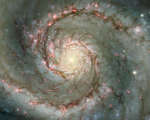 M51: The Whirlpool Galaxy in Dust and Stars
24.02.2013
The Whirlpool Galaxy is a classic spiral galaxy. At only 30 million light years distant and fully 60 thousand light years across, M51, also known as NGC 5194, is one of the brightest and most picturesque galaxies on the sky.
|
January February March April May June July August September October |
|||||||||||||||||||||||||||||||||||||||||||||||||