
|
You entered: galaxy center
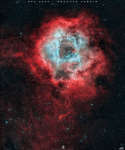 Roses are Red
14.02.2026
Roses are red, nebulas are too, and this Valentine's gift is a stunning view! Pictured is a loving look at the Rosette Nebula (NGC 2237): a cosmic bloom of bright young stars sitting atop a stem of glowing hot gas.
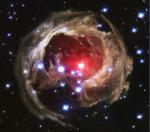 V838 Mon: Echoes from the Edge
5.03.2004
Variable star V838 Monocerotis lies near the edge of our Milky Way Galaxy, about 20,000 light-years from the Sun. Still, ever since a sudden outburst was detected in January 2002, this enigmatic star...
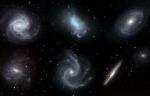 Visitors Galaxy Gallery
27.04.2001
A tantalizing assortment of island universes is assembled here. From top left to bottom right are the lovely but distant galaxies M61, NGC 4449, NGC 4725, NGC 5068, NGC 5247, and NGC 5775/5774. Most are spiral galaxies more or less like our own Milky Way.
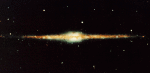 The Milky Way's Center
8.09.1995
NASA's COBE satellite scanned the heavens at infrared wavelengths in 1990 and produced this premier view of the central region of our own Milky Way Galaxy. The Milky Way is a typical spiral galaxy with a central bulge and extended disk of stars.
 Visitors Galaxy Gallery
18.06.2005
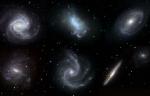
A tantalizing assortment of island universes is assembled here. From top left to bottom right are the lovely but distant galaxies M61, NGC 4449, NGC 4725, NGC 5068, NGC 5247, and NGC 5775/5774. Most are spiral galaxies more or less like our own Milky Way.
 Abell 2142: Clash of the Galaxy Clusters
6.03.2000
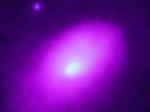
Over the course of billions of years, whole clusters of galaxies merge. Above is an X-ray image of Abell 2142, the result of the collision of two huge clusters of galaxies, and one of the most massive objects known in the universe.
 Bright Galaxy M81
20.06.2002
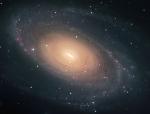
Big and beautiful spiral galaxy M81, in the northern constellation Ursa Major, is one of the brightest galaxies visible in the skies of planet Earth. This superbly detailed view reveals its bright nucleus, grand spiral arms and sweeping cosmic dust lanes with a scale comparable to the Milky Way.
 NGC 602 in the Flying Lizard Nebula
6.03.2015
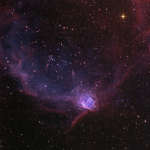
Near the outskirts of the Small Magellanic Cloud, a satellite galaxy some 200 thousand light-years distant, lies 5 million year young star cluster NGC 602. Surrounded by natal gas and dust, NGC 602 is just below center in this telescopic field of view with the angular size of the Full Moon on the sky.
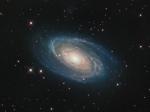 Bright Galaxy M81
7.07.2006
Big and beautiful spiral galaxy M81 lies in the northern constellation Ursa Major. One of the brightest galaxies in planet Earth's sky, M81 is also home to the second brightest supernova seen in modern times.
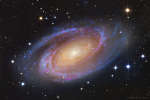 Bright Spiral Galaxy M81
18.11.2014
One of the brightest galaxies in planet Earth's sky is similar in size to our Milky Way Galaxy: big, beautiful M81. This grand spiral galaxy can be found toward the northern constellation of the Great Bear (Ursa Major).
|
January February March April May June July August |
||||||||||||||||||||||||||||||||||||||||||||||||||||||||