
|
You entered: Earth
 APOD: 2024 September 22 Б Chicagohenge: Equinox in an Aligned City
22.09.2024
Chicago, in a way, is like a modern Stonehenge. The way is east to west, and the time is today. Today, and every equinox, the Sun will set exactly to the west, everywhere on Earth.
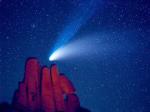 Comet Hale Bopp Over Indian Cove
20.04.2004
Comet Hale-Bopp, the Great Comet of 1997, was quite a sight. No comets of comparable brightness have graced the skies of Earth since then. During this next month, however, even besides the fleeting Comet Bradfield, two comets have a slight chance of rivaling Hale-Bopp and a good chance of putting on a memorable sky show.
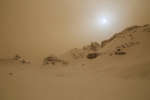 Swiss Alps, Martian Sky
18.02.2021
Taken on February 6, this snowy mountain and skyscape was captured near Melchsee-Frutt, central Switzerland, planet Earth. The reddish daylight and blue tinted glow around the afternoon Sun are colors of the Martian sky, though. Of course both worlds have the same Sun.
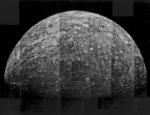 Mercury: Closest Planet to the Sun
14.08.1995
This picture was compiled from images taken by the NASA spacecraft Mariner 10 which flew by the planet three times in 1974. Mercury is the closest planet to the Sun, the second hottest planet (Venus gets hotter), and the second smallest planet (Pluto is smaller).
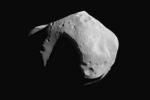 NEAR Mathilde
30.06.1997
Hey Earth, look what I found! On the way to visiting the asteroid 433 Eros in February 1999, the Near Earth Asteroid Rendezvous (NEAR) spacecraft flew right by another asteroid: 253 Mathilde last Friday. Shown above is one picture from the encounter.
 Solar Eclipse: A Composite View
27.02.1998
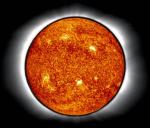
Yesterday, the Moon's shadow reached out and touched the Earth, treating a large portion of the Western Hemisphere to an Eclipse of the Sun. This composite image combines pictures of the Sun made from both Earth and space.
 The Cygnus Wall of Star Formation
21.06.2005
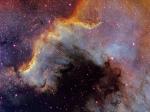
The North America Nebula in the sky can do what North Americans on Earth cannot -- form stars. Specifically, in analogy to the Earth-confined continent, the bright part that appears as Central America and Mexico is actually a hot bed of gas, dust, and newly formed stars known as the Cygnus Wall.
 Fire Glow and Star Trails at Sunset Crater
7.07.2005
Stars gracefully arc over the glow from a not too distant forest fire in this dramatic time exposure. A recent camping trip with family and friends to Sunset Crater Volcano National Monument, near Flagstaff, Arizona, USA produced the opportunity to record the subtle lighting from Earth and sky.
 Mars Opposition 2010
29.01.2010
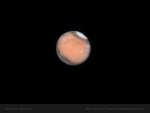
Mars is at opposition tonight, opposite the Sun in planet Earth's sky. Of course, it will be easy to spot because Mars appears close to tonight's Full Moon, also opposite the Sun in Earth's night sky in the constellation Cancer.
 Venus at the Edge
9.06.2012
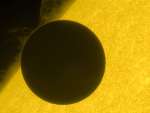
As its June 6 2012 transit begins Earth's sister planet crosses the edge of the Sun in this stunning view from the Hinode spacecraft. The timing of limb crossings during the rare transits was used historically to triangulate the distance to Venus and determine a value for the Earth-Sun distance called the astronomical unit.
|
January February March April May June July August September October |
|||||||||||||||||||||||||||||||||||||||||||||||||