
|
You entered: Earth
 Olympus Mons Volcano on Mars
29.05.2000
Scroll right to virtually climb the largest volcano in the Solar System. Olympus Mons on Mars measures three times higher than Earth's highest mountain, and has a volume over fifty times greater than Earth's largest volcano. The caldera at the top is over 70 kilometers wide.
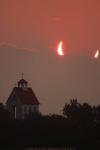 Clouds and the Moon Move to Block the Sun
18.06.2003
High above a small church near Vienna, Austria, clouds and the Moon vied for position in front of the Sun. Such was the case on the ground late last month during a partial eclipse of the Sun visible throughout Europe and Asia.
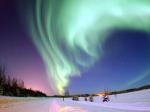 Aurora Over Alaska
9.04.2007
Higher than the highest mountain, higher than the highest airplane, lies the realm of the aurora. Aurora rarely reach below 60 kilometers, and can range up to 1000 kilometers. Aurora light results from solar shockwave causing energetic electrons and protons to striking molecules in the Earth's atmosphere.
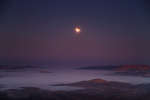 Eclipse at Moonset
9.10.2014
The Pacific Ocean and Chilean coast lie below this sea of clouds. Seen through the subtle colors of the predawn sky a lunar eclipse is in progress above, the partially eclipsed Moon growing dark.
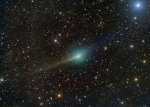 3I/ATLAS Flyby
25.12.2025
Attention grabbing interstellar visitor 3I/ATLAS made its not-so-close flyby of our fair planet on December 19 at a distance of 1.8 astronomical units. That's about 900 light-seconds. This deep exposure captures the comet...
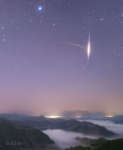 APOD: 2026 January 12 Б Meteor Dust
11.01.2026
What's happening to this meteor? It is shedding its outer layers as it passes through the Earth's atmosphere and heats up. The sudden high temperatures not only cause the bright glow along the dramatic streak but also melt and vaporize the meteor's component rock and ice, creating dust.
 When Vega is North
7.05.2015
In only about 12,000 years Vega will be the North Star, the closest bright star to our fair planet's North Celestial Pole. By then, when you fix your camera to a tripod...
 Full Moon, Full Mars
17.01.2025
On January 13 a Full Moon and a Full Mars were close, both bright and opposite the Sun in planet Earth's sky. In fact Mars was occulted, passing behind the Moon, when viewed from some locations in North America and northwest Africa.
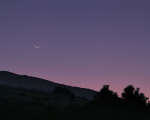 Friday the Moon Smiled
17.11.2017
Friday, an old Moon smiled for early morning risers. Its waning sunlit crescent is captured in this atmospheric scene from clear skies near Bursa, Turkey, planet Earth. In the subtle twilight hues nearby celestial lights are Jupiter (top) and Venus shining close to the eastern horizon.
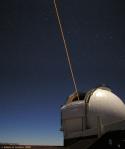 A Telescope Laser Creates an Artificial Star
6.02.2005
What do you get when you combine one of the world's most powerful telescopes with a powerful laser? An artificial star. Monitoring fluctuations in brightness of a genuine bright star can indicate how the Earth's atmosphere is changing, but many times no bright star exists in the direction where atmospheric information is needed.
|
January February March April May June July August September October |
|||||||||||||||||||||||||||||||||||||||||||||||||