
|
You entered: wind
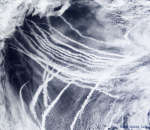 Ship Tracks over the Pacific Ocean
8.06.2022
What are those unusual streaks? Some images of planet Earth show clear bright streaks that follow the paths of ships. Known as ship tracks, these low and narrow bands are caused by the ship's engine exhaust.
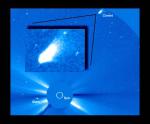 Discovery Image: Comet SOHO (1998 J1)
20.05.1998
Staring at the Sun from a vantage point in space (Kids, don't try this at home!), the Solar and Heliospheric Observatory (SOHO) has enabled the discovery of much about our closest star. It has also been used to discover about 50 comets.
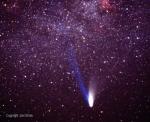 Exploring Comet Tails
13.04.2000
Comets are known for their tails. In the spring of 1997 and 1996 Comet Hale-Bopp (above) and Comet Hyakutake gave us stunning examples as they passed near the Sun. These extremely active comets were...
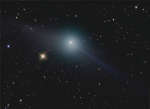 The Opposing Tails of Comet Garradd
28.02.2012
Why does Comet Garradd have two tails? Visible on the left, Comet Garradd's dust tail is composed of ice and dust bits that trial the comet in its orbit around the Sun. Visible...
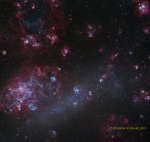 Clouds in the LMC
19.01.2018
An alluring sight in southern skies, the Large Magellanic Cloud (LMC) is seen in this deep and detailed telescopic mosaic. Recorded with broadband and narrowband filters, the scene spans some 5 degrees or 10 full moons. The narrowband filters are designed to transmit only light emitted by hydrogen, and oxygen atoms.
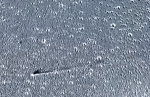 Comet Leonards Tail Wag
10.01.2022
Why does Comet Leonard's tail wag? The featured time-lapse video shows the ion tail of Comet C/2021 A1 (Leonard) as it changed over ten days early last month. The video was taken by NASA's Solar Terrestrial Relations Observatory-Ahead (STEREO-A) spacecraft that co-orbits the Sun at roughly the same distance as the Earth.
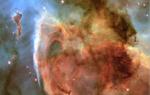 Colorful Clouds Of Carina
3.02.2000
Tumultuous clouds of the Carina Nebula, 8000 light-years away, glow in planet Earth's southern sky. Striking and detailed, this close-up of a portion of the famous nebula is a combination of exposures through six different filters taken with the Hubble Space Telescope's Wide Field Planetary Camera 2 in April of 1999.
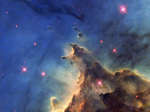 NGC 2174: Stars Versus Mountains
9.02.2011
It's stars versus gas mountains in NGC 2174 and the stars are winning. More precisely, the energetic light and winds from massive newly formed stars are evaporating and dispersing the dark stellar nurseries in which they formed.
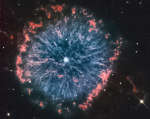 NGC 6751: The Glowing Eye Nebula
13.03.2013
Planetary nebulae can look simple, round, and planet-like in small telescopes. But images from the orbiting Hubble Space Telescope have become well known for showing these fluorescent gas shrouds of dying Sun-like stars to possess a staggering variety of detailed symmetries and shapes.
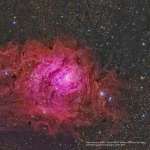 Pan STARRS Across the Lagoon
25.04.2019
Ridges of glowing interstellar gas and dark dust clouds inhabit the turbulent, cosmic depths of the Lagoon Nebula. Also known as M8, the bright star forming region is about 5,000 light-years distant.
|
January February March April May June July August September |
|||||||||||||||||||||||||||||||||||||||||||||||||