
|
You entered: wind
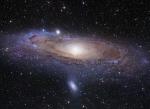 Andromeda Island Universe
22.12.2005
The most distant object easily visible to the unaided eye is M31, the great Andromeda Galaxy some two million light-years away. But without a telescope, even this immense spiral galaxy - spanning over 200,000 light years - appears as a faint, nebulous cloud in the constellation Andromeda.
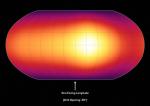 HD 189733b: Hot Jupiter
12.05.2007
HD 189733b is a Jupiter-sized planet known to orbit a star some 63 light-years away. But while the distant world is approximately the size of Jupiter, its close-in orbit makes it much hotter than our solar system's ruling gas giant.
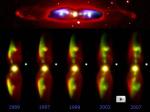 Monitoring M2-9
18.06.2007
Exploring the myriad shapes found in the cosmic zoo of planetary nebulae, some astronomers have focused on the intriguing example of M2-9. About 2,100 light-years away and over one light-year across, M2-9 is known as a twin jet or butterfly nebula in reference to its striking bipolar symmetry.
 Cluster and Starforming Region Westerlund 2
25.04.2015
Located 20,000 light-years away in the constellation Carina, the young cluster and starforming region Westerlund 2 fills this cosmic scene. Captured with Hubble's cameras in near-infrared and visible light, the stunning image is a celebration of the 25th anniversary of the launch of the Hubble Space Telescope on April 24, 1990.
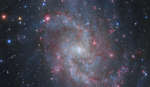 The Hydrogen Clouds of M33
7.10.2016
Gorgeous spiral galaxy M33 seems to have more than its fair share of glowing hydrogen gas. A prominent member of the local group of galaxies, M33 is also known as the Triangulum Galaxy and lies about 3 million light-years distant.
 Comet Hale Bopp Over Val Parola Pass
9.04.2017
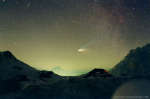
Comet Hale-Bopp, the Great Comet of 1997, became much brighter than any surrounding stars. It was seen even over bright city lights. Away from city lights, however, it put on quite a spectacular show. Here Comet Hale-Bopp was photographed above Val Parola Pass in the Dolomite mountains surrounding Cortina d'Ampezzo, Italy.
 X Rays from M17
21.08.2003
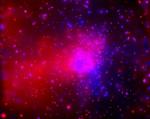
About 5,000 light-years away, toward the constellation Sagittarius and the center of our galaxy, lies the bright star forming region cataloged as M17. In visible light, M17's bowed and hollowed-out appearance has resulted in many popular names like the Horseshoe, Swan, Omega, and Lobster nebula. But what has sculpted this glowing gas cloud?
 The Tarantula Zone
23.08.2003
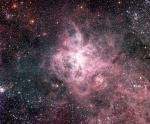
The Tarantula Nebula is more than 1,000 light-years across - a giant emission nebula within our neighboring galaxy the Large Magellanic Cloud. Inside this cosmic arachnid lies a central young cluster of massive stars, cataloged as R136, whose intense radiation and strong winds have helped energize the nebular glow and shape the spidery filaments.
 Elliptical M60, Spiral NGC 4647
14.09.2012
Giant elliptical galaxy M60 and spiral galaxy NGC 4647 do look like an odd couple in this sharp cosmic portrait from the Hubble Space Telescope. But they are found in a region of space where galaxies tend to gather, on the eastern side of the nearby Virgo Galaxy Cluster.
 Solis Lacus: The Eye of Mars
1.10.2020
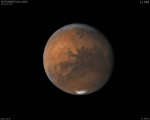
As telescopes around planet Earth watch, Mars is growing brighter in night skies, approaching its 2020 opposition on October 13. Mars looks like its watching too in this view of the Red Planet from September 22.
|
January February March April May June July August September |
|||||||||||||||||||||||||||||||||||||||||||||||||