
|
You entered: space
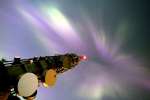 Auroral Corona Over Norway
31.01.2009
Higher than highest communications tower, higher than highest mountain, higher than highest airplane, lies the realm of the aurora. Auroras rarely reach below 60 kilometers, and can range up to 1000 kilometers. Aurora light results from energetic electrons and protons striking molecules in the Earth's atmosphere.
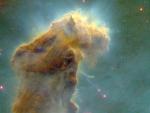 Eagle EGGs in M16
12.08.2001
Star forming regions known as "EGGs" are uncovered at the end of this giant pillar of gas and dust in the Eagle Nebula (M16). EGGs, short for evaporating gaseous globules, are dense regions of mostly molecular hydrogen gas that fragment and gravitationally collapse to form stars.
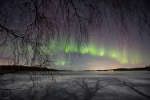 Aurora by Moonlight
11.02.2022
The ice was singing as light from a bright gibbous Moon cast shadows across this frozen lake, about 20 kilometers north of Stockholm, Sweden, planet Earth. In the alluring night skyscape captured on February 10, shimmering auroral curtains of light dance in the evening sky.
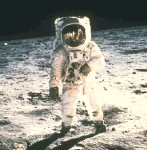 Standing on the Moon
22.09.1995
Pictured, the second person to walk on the Moon: Edwin "Buzz" Aldrin. During this Apollo 11 mission, Neil Armstrong and Buzz Aldrin landed on the Moon while Michael Collins circled in the Command Module above.
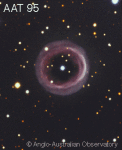 Shapley 1: An Annular Planetary Nebula
11.12.1995
This strange structure is what can result when a normal star runs out of nuclear fuel in its core. At that time, the center condenses into a white dwarf while the outer atmospheric layers are expelled into space and appear as a planetary nebula.
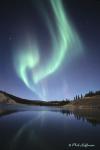 Dueling Auroras
7.08.2005
Will it be curtains for one of these auroras? A quick inspection indicates that it is curtains for both, as the designation "curtains" well categorizes the type of aurora pattern pictured. Another (informal) type is the corona.
 Rocket Eclipse at Sunset
27.09.2024
Shockwaves ripple across the glare as a launch eclipses the setting Sun in this exciting close-up. Captured on September 17, the roaring Falcon 9 rocket carried European Galileo L13 navigation satellites to medium Earth orbit after a lift-off from Cape Canaveral on Florida's space coast.
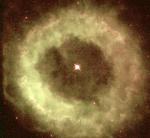 NGC 6369: A Donut Shaped Nebula
18.05.1998
Why isn't the star in the center of the nebula? NGC 6369 appears to be a fairly ordinary planetary nebula. It can be seen with a good telescope in the constellation of Ophiuchus. The gas expelled by the central star is bunched in the shape of a donut or cylinder.
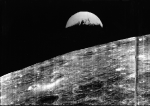 The Earth Also Rises
13.10.1996
The Lunar Orbiter 1 spacecraft was launched in 1966 to map the lunar surface in preparation for the Apollo moon landings. NASA's plucky robotic explorer performed its job well and pioneered this classic view of the Earth poised above the lunar horizon.
 A Northern Summer s Night
6.07.2018
Near a summer's midnight a mist haunts the river bank in this dreamlike skyscape taken on July 3rd from northern Denmark. Reddened light from the Sun a little below the horizon gives an eerie tint to low hanging clouds.
|
January February March April May June July August September |
|||||||||||||||||||||||||||||||||||||||||||||||||