
|
You entered: space
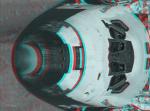 Discovery Orbiter Anaglyph
16.09.2006
Approaching the International Space Station on STS-121 in July, the Shuttle Orbiter Discovery posed for a series of photographs. The process was part of an inspection to check for damage to the orbiter, but against the backdrop of planet Earth 300 kilometers below, the pictures themselves are stunning.
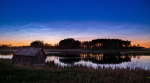 Northern Summer Twilight
19.06.2021
Nights grow shorter and days grow longer as the summer solstice approaches in the north. Usually seen at high latitudes in summer months, noctilucent or night shining clouds begin to make their appearance. Drifting...
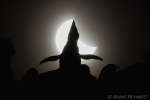 Ecstatic Solar Eclipse
7.01.2022
A male Adelie penguin performed this Ecstatic Vocalization in silhouette during the December 4 solar eclipse, the final eclipse of 2021. Of course his Ecstatic Vocalization is a special display that male penguins use to claim their territory and advertise their condition.
 Fireworks vs Supermoon
6.07.2023
On July 4, an almost Full Moon rose in planet Earth's evening skies. Also known as a Buck Moon, the full lunar phase (full on July 3 at 11:39 UTC) was near perigee, the closest point in the Moon's almost monthly orbit around planet Earth.
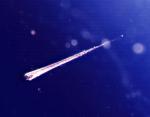 Catching Falling Stardust
17.11.2001
This carrot-shaped track is actually little more than 5 hundredths of an inch long. It is the trail of a meteroid through the high-tech substance aerogel exposed to space by the shuttle launched EURECA (European Recoverable Carrier) spacecraft.
 The Dawn of the Clusters
15.01.1996
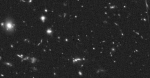
What did the universe look like near the beginning? This exciting photo by the Hubble Space Telescope is one of the deepest ever taken, and shows galaxies as far away as ever before photographed. The universe back then - when only one third of its present age - was a strange and violent place.
 Stars from Eagle's EGGs
12.04.1998
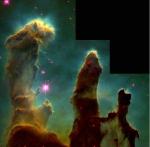
Newborn stars are forming in the Eagle Nebula. This image, taken with the Hubble Space Telescope in 1995, shows evaporating gaseous globules (EGGs) emerging from pillars of molecular hydrogen gas and dust. The giant pillars are light years in length and are so dense that interior gas contracts gravitationally to form stars.
 Edwin Hubble Discovers the Universe
21.06.1998
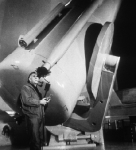
No person in history has had greater impact in determining the extent of our universe than Edwin Hubble. From proving that other galaxies existed to proving that galaxies move apart from one another, Hubble's work defined our place in the cosmos.
 A Hurricane in the Gulf
28.09.1998
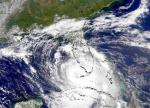
Last Friday, Hurricane Georges was photographed from space entering the Gulf of Mexico. This immense storm system, larger than most states, is expected to make landfall today. Starting as a slight pressure difference, hurricanes grow into large spiraling storm systems of low pressure, complete with high winds and driving rain.
 Mars Climate Orbiter Launches
24.12.1998
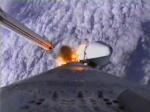
Looking down from atop a Delta II rocket blasting skyward, solid fuel boosters fall away (left) and the Earth's limb slides into view. These pictures from the launch of the Mars Climate Orbiter were taken as it climbed away from Cape Canaveral Air Station Space Launch Complex 17 on December 11.
|
January February March April May June July August September |
|||||||||||||||||||||||||||||||||||||||||||||||||