
|
You entered: star
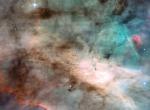 In the Center of the Omega Nebula
8.02.2004
In the depths of the dark clouds of dust and molecular gas known as the Omega Nebula, stars continue to form. The above image from the Hubble Space Telescope's Advanced Camera for Surveys shows exquisite detail in the famous star-forming region.
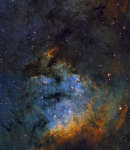 NGC 7822 in Cepheus
22.10.2010
Pillars of gas, dust, and young, hot stars seem to fill the gaping maw of NGC 7822. At the edge of a giant molecular cloud toward the northern constellation Cepheus, the glowing star forming region lies about 3,000 light-years away. Within the nebula, bright edges and dark shapes are highlighted in this colorful skyscape.
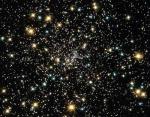 Blue Stragglers in NGC 6397
8.08.2003
In our neck of the Galaxy stars are too far apart to be in danger of colliding, but in the dense cores of globular star clusters star collisions may be relatively common. In fact...
 APOD: 2024 August 4 Б Gaia: Here Comes the Sun
4.08.2024
What would it look like to return home from outside our galaxy? Although designed to answer greater questions, data from ESA's robotic Gaia mission is helping to provide a uniquely modern perspective on humanity's place in the universe.
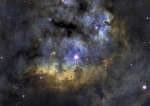 NGC 7822 in Cepheus
16.11.2011
Hot, young stars and cosmic pillars of gas and dust seem to crowd into NGC 7822. At the edge of a giant molecular cloud toward the northern constellation Cepheus, the glowing star forming region lies about 3,000 light-years away. Within the nebula, bright edges and dark shapes are highlighted in this colorful skyscape.
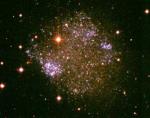 Irregular Galaxy Sextans A
18.12.1999
Grand spiral galaxies often seem to get all the glory. Their newly formed, bright, blue star clusters found along beautiful, symmetric spiral arms are guaranteed to attract attention. But small irregular galaxies form stars too, like this lovely, gumdrop-shaped galaxy, Sextans A.
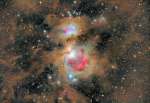 Dust of the Orion Nebula
6.02.2012
What surrounds a hotbed of star formation? In the case of the Orion Nebula -- dust. The entire Orion field, located about 1600 light years away, is inundated with intricate and picturesque filaments of dust.
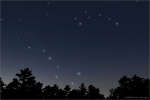 The Big Dipper
21.04.2013
Do you see it? This common question frequently precedes the rediscovery of one of the most commonly recognized configurations of stars on the northern sky: the Big Dipper. This grouping of stars is one of the few things that has likely been seen, and will be seen, by every generation.
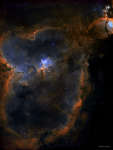 Bright from the Heart Nebula
27.10.2015
What's that inside the Heart Nebula? First, the large emission nebula dubbed IC 1805 looks, in whole, like a human heart. The nebula glows brightly in red light emitted by its most prominent element: hydrogen.
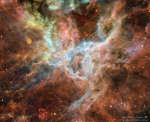 In the Heart of the Tarantula Nebula
20.05.2018
In the heart of monstrous Tarantula Nebula lies huge bubbles of energetic gas, long filaments of dark dust, and unusually massive stars. In the center of this heart, is a knot of stars so dense that it was once thought to be a single star.
|
January February March April May June July August September |
|||||||||||||||||||||||||||||||||||||||||||||||||