
|
You entered: star
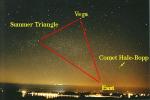 Vega
Vega
15.07.1997
Vega is a bright blue star 25 light years away. Vega is the brightest star in the Summer Triangle, a group of stars easily visible summer evenings in the northern hemisphere. The name Vega...
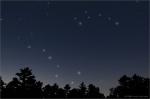 The Big Dipper
8.01.2007
Do you see it? This common question frequently precedes the rediscovery of one of the most commonly recognized configurations of stars on the northern sky: the Big Dipper. This grouping of stars is one of the few things that has likely been seen, and will be seen, by every generation.
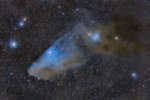 IC 4592: The Blue Horsehead Reflection Nebula
2.04.2013
Do you see the horse's head? What you are seeing is not the famous Horsehead nebula toward Orion but rather a fainter nebula that only takes on a familiar form with deeper imaging. The main part of the above imaged molecular cloud complex is a reflection nebula cataloged as IC 4592.
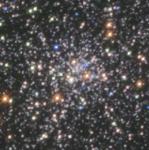 At The Core Of M15
17.01.1998
Densely packed stars in the core of the globular cluster M15 are shown in this Hubble Space Telescope (HST) image. The star colors roughly indicate their temperatures - hot stars appear blue, cooler stars look reddish-orange.
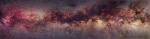 A Milky Way Band
5.06.2005
Most bright stars in our Milky Way Galaxy reside in a disk. Since our Sun also resides in this disk, these stars appear to us as a diffuse band that circles the sky.
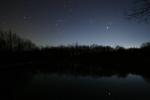 Venus by the Lake
14.04.2007
Finding Venus in the night sky is not too hard these days. Now appearing as the evening star, Venus rules as the brightest celestial beacon in west just after sunset. And if you can find Venus tonight, you can also easily find the lovely Pleiades star cluster (aka M45) close by.
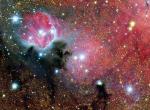 East of the Lagoon Nebula
20.05.2002
To the east of the Lagoon Nebula is a star field rich in diversity. On the lower left are clouds rich in dark dust that hide background stars and young star systems still forming. Dark clouds include LDN 227 on the left and IC 1275 on the right, with a bright star near its tip.
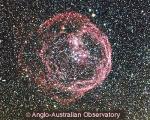 Henize 70: A SuperBubble In The LMC
13.06.1998
Stars with tens of times the mass of the Sun profoundly affect their galactic environment. Churning and mixing the interstellar gas and dust clouds they leave their mark in the compositions and locations of future generations of stars and star systems.
 Light from the Heart Nebula
3.10.2006
What powers the Heart Nebula? The large emission nebula dubbed IC 1805 looks, in whole, like a human heart. The nebula glows brightly in red light emitted by its most prominent element: hydrogen. The red glow and the larger shape are all created by a small group of stars near the nebula's center.
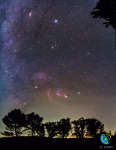 Comet Lovejoy in a Winter Sky
27.01.2015
Which of these night sky icons can you find in this beautiful and deep exposure of the northern winter sky? Skylights include the stars in Orion's belt, the Orion Nebula, the Pleiades star cluster, the bright stars Betelgeuse and Rigel, the California Nebula, Barnard's Loop, and Comet Lovejoy.
|
January February March April May June July August September |
|||||||||||||||||||||||||||||||||||||||||||||||||