
|
You entered: space
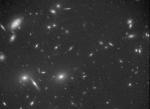 A Distant Cluster of Galaxies
7.12.1997
In this 1994 Hubble Space Telescope photograph, every bright object is a galaxy. Oddly - most of them are spiral galaxies. This rich cluster of galaxies, named CL 0939+4713, is almost half way across the visible universe.
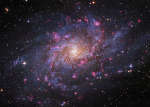 The Hydrogen Clouds of M33
3.10.2019
Gorgeous spiral galaxy M33 seems to have more than its fair share of glowing hydrogen gas. A prominent member of the local group of galaxies, M33 is also known as the Triangulum Galaxy and lies a mere 3 million light-years away.
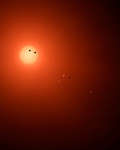 Seven Worlds for TRAPPIST 1
23.02.2017
Seven worlds orbit the ultracool dwarf star TRAPPIST-1, a mere 40 light-years away. In May 2016 astronomers using the Transiting Planets and Planetesimals Small Telescope (TRAPPIST) announced the discovery of three planets in the TRAPPIST-1 system.
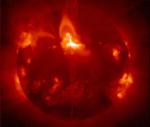 Active Regions, CMEs, and X Class Flares
8.06.2000
Space Weather forcasters are predicting major storm conditions over the next few days as the active Sun has produced at least three strong flares and a large coronal mass ejection (CME) since Tuesday, June 6th.
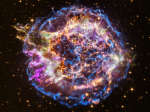 Recycling Cassiopeia A
6.09.2019
Massive stars in our Milky Way Galaxy live spectacular lives. Collapsing from vast cosmic clouds, their nuclear furnaces ignite and create heavy elements in their cores. After a few million years, the enriched material is blasted back into interstellar space where star formation can begin anew.
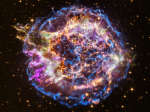 Recycling Cassiopeia A
23.01.2021
Massive stars in our Milky Way Galaxy live spectacular lives. Collapsing from vast cosmic clouds, their nuclear furnaces ignite and create heavy elements in their cores. After a few million years, the enriched material is blasted back into interstellar space where star formation can begin anew.
 Recycling Cassiopeia A
1.06.2023
Massive stars in our Milky Way Galaxy live spectacular lives. Collapsing from vast cosmic clouds, their nuclear furnaces ignite and create heavy elements in their cores. After a few million years, the enriched material is blasted back into interstellar space where star formation can begin anew.
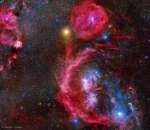 A 212 Hour Exposure of Orion
23.11.2015
The constellation of Orion is much more than three stars in a row. It is a direction in space that is rich with impressive nebulas. To better appreciate this well-known swath of sky, an extremely long exposure was taken over many clear nights in 2013 and 2014.
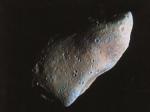 Asteroid Gaspra's Best Face
12.07.1998
Asteroid 951 Gaspra is a huge rock tumbling in space. Gaspra became one of the best-studied asteroids in 1991 when the spacecraft Galileo flew by. In the above photograph, subtle color variations have been exaggerated to highlight changes in reflectivity, surface structure and composition.
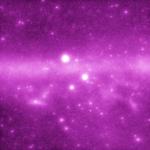 GLAST Gamma Ray Sky Simulation
22.07.2000
What shines in the gamma-ray sky? This simulated image models the intensities of gamma rays with over 40 million times the energy of visible light, and represents how the sky might appear to the Gamma-ray Large Area Space Telescope (GLAST) after its first year in orbit.
|
January February March April May June July August September |
|||||||||||||||||||||||||||||||||||||||||||||||||