
|
You entered: white dwarf
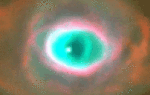 The Eye of an Hourglass Nebula
9.02.1996
What's happening in the eye-like center of this planetary nebula? The geometry revealed in this Hubble Space Telescope view of the central part of an "etched hourglass nebula" known as MyCn 18 presents a puzzle. First, the axis of this central region does not line up well with the outer hourglass structure.
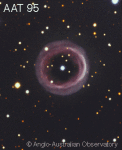 Shapley 1: An Annular Planetary Nebula
12.12.1995
This strange structure is what can result when a normal star runs out of nuclear fuel in its core. At that time, the center condenses into a white dwarf while the outer atmospheric layers are expelled into space and appear as a planetary nebula.
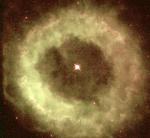 NGC 6369: A Donut Shaped Nebula
18.05.1998
Why isn't the star in the center of the nebula? NGC 6369 appears to be a fairly ordinary planetary nebula. It can be seen with a good telescope in the constellation of Ophiuchus. The gas expelled by the central star is bunched in the shape of a donut or cylinder.
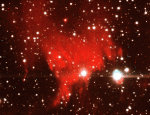 Nebula Nova Cygni Turns On
16.12.1996
Old photographs show no evidence of the above nebula. In 1992, a white dwarf star in Cygnus blew off its outer layers in a classical nova explosion: an event called Nova Cygni 1992. Light flooded the local interstellar neighborhood, illuminated this existing gas cloud, excited the existing hydrogen, and hence caused the red emission.
 Methane Dwarf
3.06.1999
While hunting through Sloan Sky Survey data in search of distant quasars, Princeton astronomers Xiaohui Fan and Michael Strauss came upon an undiscovered type of object very nearby - now dubbed a methane dwarf. Marked...
 The Sun Erupts
13.08.1995
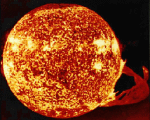
The sun was captured in 1973 throwing one of the largest eruptive prominences ever recorded. Sol, our sun, is a normal star. It formed about 5 billion years ago, and will last about another 5 billion years. The sun will never explode, and a solar flare will never destroy the earth.
 IC 4406: A Seemingly Square Nebula
27.04.1998
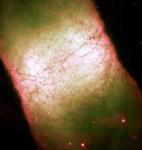
How can a round star make a square nebula? This conundrum came to light with the discovery of planetary nebulae like IC 4406. IC 4406 is most probably cylindrical, with its square appearance the result of our vantage point in viewing the cylinder.
 The Firework Nebula
4.07.1998
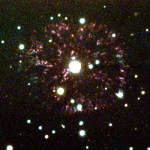
Imaged by the WIYN Telescope, the Firework Nebula is the result of a type of stellar explosion called a nova. In a nova, a nuclear detonation on the surface of a compact white dwarf star blasts away material that has been dumped on its surface by a companion star.
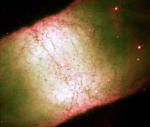 IC 4406: A Seemingly Square Nebula
16.04.2000
How can a round star make a square nebula? This conundrum came to light with the discovery of planetary nebulae like IC 4406. IC 4406 is most probably cylindrical, with its square appearance the result of our vantage point in viewing the cylinder.
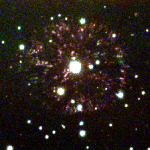 The Firework Nebula
4.07.1995
The Firework Nebula, known to astronomers as "GK Per", is the result of a type of stellar explosion called a nova. In a nova, a very compact star called a white dwarf blasts away gas that had accumulated on its surface.
|
January February March April May June July August September |
|||||||||||||||||||||||||||||||||||||||||||||||||