
|
You entered: annular
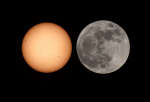 Sun vs Super Moon
11.05.2012
The Super Moon wins, by just a little, when its apparent size is compared to the Sun in this ingenious composite picture. To make it, the Full Moon on May 6 was photographed with the same camera and telescope used to image the Sun (with a dense solar filter!) on the following day.
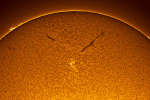 A Sunspot in the New Solar Cycle
5.02.2008
A new cycle has begun on our Sun. Over the past year, the Sun's magnetic field has reset and now a new 11 year period is beginning. Pictured above in a specific color of light emitted by hydrogen is sunspot 10982, one of the first sunspots of the new solar cycle.
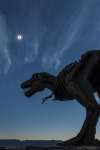 Eclipsosaurus Rex
6.10.2017
We live in an era where total solar eclipses are possible because at times the apparent size of the Moon can just cover the disk of the Sun. But the Moon is slowly moving away from planet Earth. Its distance is measured to increase about 1.5 inches (3.8 centimeters) per year due to tidal friction.
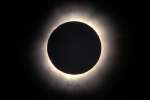 Total Solar Eclipse of 1979
18.08.2017
From cold, clear skies over Riverton, Manitoba, Canada, planet Earth, the solar corona surrounds the silhouette of the New Moon in this telescopic snapshot of the total solar eclipse of February 26, 1979. Thirty eight years ago, it was the last total solar eclipse visible from the contiguous United States.
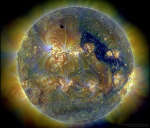 Venus and the Triply Ultraviolet Sun
5.03.2022
This was a very unusual type of solar eclipse. Typically, it is the Earth's Moon that eclipses the Sun. In 2012, though, the planet Venus took a turn. Like a solar eclipse by the Moon, the phase of Venus became a continually thinner crescent as Venus became increasingly better aligned with the Sun.
 Solar Eclipse from Western Australia
20.04.2023
Along a narrow path that mostly avoided landfall, the shadow of the New Moon raced across planet Earth's southern hemisphere on April 20 to create a rare annular-total or hybrid solar eclipse.
 APOD: 2023 October 15 Б An Eclipse Tree
14.10.2023
Yes, but can your tree do this? If you look closely at the ground in the featured image, you will see many images of yesterday's solar eclipse -- created by a tree. Gaps between...
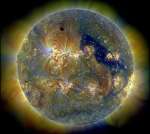 Venus and the Triply Ultraviolet Sun
20.08.2013
An unusual type of solar eclipse occurred last year. Usually it is the Earth's Moon that eclipses the Sun. Last June, most unusually, the planet Venus took a turn. Like a solar eclipse by the Moon, the phase of Venus became a continually thinner crescent as Venus became increasingly better aligned with the Sun.
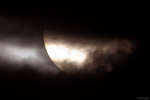 Mercurys Transit: An Unusual Spot on the Sun
7.05.2016
What's that dot on the Sun? If you look closely, it is almost perfectly round. The dot is the result of an unusual type of solar eclipse that occurred in 2006. Usually it is the Earth's Moon that eclipses the Sun. This time, the planet Mercury took a turn.
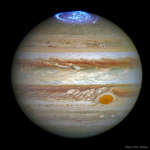 Aurorae on Jupiter
10.07.2016
Jupiter has aurorae. Like Earth, the magnetic field of the gas giant funnels charged particles released from the Sun onto the poles. As these particles strike the atmosphere, electrons are temporarily knocked away from existing gas molecules. Electric force attracts these electrons back. As the electrons recombine to remake neutral molecules, auroral light is emitted.
|
January February March April May June July August September |
|||||||||||||||||||||||||||||||||||||||||||||||||