
|
You entered: Mars
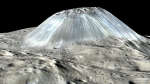 Unusual Mountain Ahuna Mons on Asteroid Ceres
9.10.2017
What created this unusual mountain? Ahuna Mons is the largest mountain on the largest known asteroid in our Solar System, Ceres, which orbits our Sun in the main asteroid belt between Mars and Jupiter. Ahuna Mons, though, is like nothing that humanity has ever seen before.
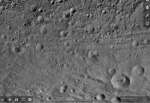 Vesta Trek: A Digital Model of Asteroid Vesta
21.04.2015
You can explore asteroid Vesta. Recently, NASA's robotic spaceship Dawn visited Vesta, the second largest object in our Solar System's main asteroid belt, which lies between Mars and Jupiter. During a year-long stopover, Dawn's cameras photographed Vesta's entire surface, documenting all of the minor planet's major mountains and craters.
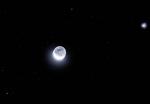 Bright Planets, Crescent Moon
11.10.2007
Early risers are currently enjoying the sight of dazzling Venus, near the eastern horizon as the morning star. Recorded on October 7, this predawn skyview does feature Venus at the upper right. It also includes a crescent Moon and Saturn (lower left).
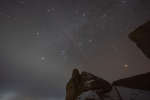 Trail of the Returner
31.12.2020
Familiar stars of a northern winter's night shine in this night skyview, taken near Zhangye, Gansu, China and the border with Inner Mongolia. During the early hours of December 17 Orion is near...
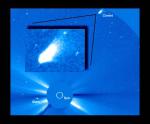 Discovery Image: Comet SOHO (1998 J1)
20.05.1998
Staring at the Sun from a vantage point in space (Kids, don't try this at home!), the Solar and Heliospheric Observatory (SOHO) has enabled the discovery of much about our closest star. It has also been used to discover about 50 comets.
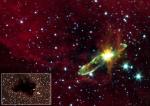 Young Star, Dark Cloud
26.12.2003
High-speed outflows of molecular gas from a young stellar object glow in infrared light, revealing themselves in this recent false-color image from the Spitzer Space Telescope. Cataloged as HH (Herbig-Haro) 46/47 the infrared source...
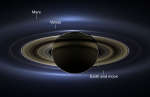 In the Shadow of Saturn
13.11.2013
In the shadow of Saturn, unexpected wonders appear. The robotic Cassini spacecraft now orbiting Saturn drifted in giant planet's shadow earlier this year and looked back toward the eclipsed Sun. Cassini saw a unique and celebrated view.
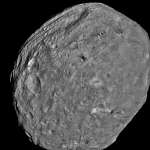 Asteroid Vesta Full Frame
2.08.2011
Why is the northern half of asteroid Vesta more heavily cratered than the south? No one is yet sure. This unexpected mystery has come to light only in the past few weeks since the robotic Dawn mission became the first spacecraft to orbit the second largest object in the asteroid belt between Mars and Jupiter.
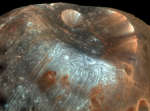 Stickney Crater
18.01.2013
Stickney Crater, the largest crater on the martian moon Phobos, is named for Chloe Angeline Stickney Hall, mathematician and wife of astronomer Asaph Hall. Asaph Hall discovered both the Red Planet's moons in 1877.
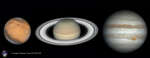 Three Planets from Pic du Midi
2.06.2016
Seen any planets lately? All three planets now shining brightly in the night sky are imaged in these panels, captured last week with the 1 meter telescope at Pic du Midi Observatory in the French Pyrenees.
|
January February March April May June July August September October |
|||||||||||||||||||||||||||||||||||||||||||||||||