
|
You entered: Mars
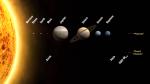 Eight Planets and New Solar System Designations
28.08.2006
How many planets are in the Solar System? This popular question now has a new formal answer according the International Astronomical Union (IAU): eight. Last week, the IAU voted on a new definition for planet and Pluto did not make the cut.
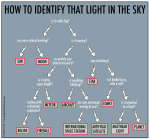 How to Identify that Light in the Sky
9.06.2014
What is that light in the sky? Perhaps one of humanity's more common questions, an answer may result from a few quick observations. For example -- is it moving or blinking?
 Late Night Vallentuna
15.08.2024
Bright Mars and even brighter Jupiter are in close conjunction just above the pine trees in this post-midnight skyscape from Vallentuna, Sweden. Taken on August 12 during a geomagnetic storm, the snapshot records the glow of aurora borealis or northern lights, beaming from the left side of the frame.
 APOD: 2024 June 9 Б How to Identify that Light in the Sky
9.06.2024
What is that light in the sky? The answer to one of humanity's more common questions may emerge from a few quick observations. For example -- is it moving or blinking?
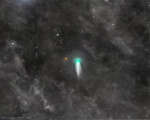 APOD: 2026 August 24 Б Comet 220P in Outburst
24.08.2026
Comet 220P is unexpectedly bright. Normally, periodic Comet 220P/McNaught is so dim that to see it requires a telescope. Two surprising outbursts this year, however, have made it about 20,000 times brighter than usual, so that it is now visible with binoculars and long-duration camera exposures.
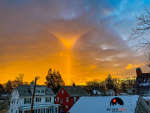 Sun Pillar with Upper Tangent Arc
17.02.2021
This was not a typical sun pillar. Just after sunrise two weeks ago in Providence, Rhode Island, USA, a photographer, looking out his window, was suddenly awestruck. The astonishment was caused by a sun pillar that fanned out at the top.
 The Clipper and the Comet
17.10.2024
NASA's Europa Clipper is now headed toward an ocean world beyond Earth. The large spacecraft is tucked into the payload fairing atop the Falcon Heavy rocket in this photo, taken at Kennedy Space Center the day before the mission's successful October 14 launch.
 Our Busy Solar System
24.07.2002
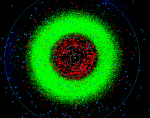
Our Solar System is a busy place. Although the major planets get the most press, a swarm of rocks, comets, and asteroids also exist. The above plot shows the placement of known inner Solar System objects on 2002 July 20. The light blue lines indicate the orbits of planets.
 Spiral Galaxy NGC 1232
25.01.2004
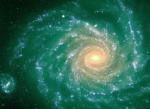
Galaxies are fascinating not only for what is visible, but for what is invisible. Grand spiral galaxy NGC 1232, captured in detail by one of the new Very Large Telescopes, is a good example.
 Ecliptic New Zealand
10.07.2010
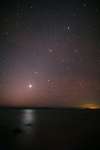
Four bright celestial beacons and a faint triangle of light follow the plane of the ecliptic as it arcs high through this southern hemisphere night skyscape. Seen on a July winter night from Lake...
|
January February March April May June July August September October |
|||||||||||||||||||||||||||||||||||||||||||||||||