
|
You entered: Mars
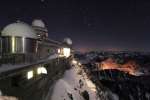 Winter Night at Pic du Midi
25.01.2008
This dreamlike view looking south from the historic mountain top Pic du Midi Observatory combines moonlit domes, a winter night sky, and the snowy peaks of the French Pyrenees. Encroaching on the night, lights...
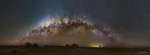 The Milky Way Sets
26.08.2016
Under dark skies the setting of the Milky Way can be a dramatic sight. Stretching nearly parallel to the horizon, this rich, edge-on vista of our galaxy above the dusty Namibian desert stretches from bright, southern Centaurus (left) to Cepheus in the north (right).
 APOD: 2023 December 12 Б Aurora and Milky Way over Norway
12.12.2023
What are these two giant arches across the sky? Perhaps the more familiar one, on the left, is the central band of our Milky Way Galaxy. This grand disk of stars and nebulas here appears to encircle much of the southern sky.
 APOD: 2024 December 3 Б Ice Clouds over a Red Planet
3.12.2024
If you could stand on Mars -- what might you see? You might look out over a vast orange landscape covered with rocks under a dusty orange sky, with a blue-tinted Sun setting over the horizon, and odd-shaped water clouds hovering high overhead.
 Asteroid Eros Reconstructed
5.06.2001
Orbiting the Sun between Mars and Earth, asteroid 433 Eros was visited by the robot spacecraft NEAR-Shoemaker in 2000 February. Some of the 100,000+ images taken by NEAR of the tumbling space rock have been combined into the above high-resolution composite.
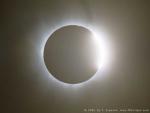 Diamond Ring in the Sun
21.06.2001
Today, earthbound skygazers can celebrate a solstice, a new Moon, the closest approach of planet Mars since 1988 ... oh yes, and a total eclipse of the Sun, the first total solar eclipse of the third millennium.
 APOD: 2025 June 11 Б 25 Brightest Stars in the Night Sky
11.06.2025
Do you know the names of some of the brightest stars? It's likely that you do, even though some bright stars have names so old they date back to near the beginning of written language.
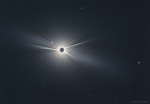 Wide Field View of Great American Eclipse
30.01.2019
Only in the fleeting darkness of a total solar eclipse is the light of the solar corona easily visible. Normally overwhelmed by the bright solar disk, the expansive corona, the sun's outer atmosphere, is an alluring sight.
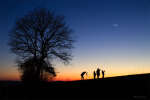 APOD: 2023 March 15 Б Jupiter and Venus Converge over Germany
15.03.2023
This was a sky to show the kids. Early this month the two brightest planets in the night sky, Jupiter and Venus, appeared to converge. At their closest, the two planets were separated by only about the angular width of the full moon.
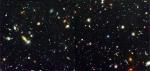 The Hubble Deep Field
7.06.1998
Galaxies like colorful pieces of candy fill the Hubble Deep Field - humanity's most distant yet optical view of the Universe. The dimmest, some as faint as 30th magnitude (about four billion times fainter...
|
January February March April May June July August September October |
|||||||||||||||||||||||||||||||||||||||||||||||||