
|
You entered: apod
 APOD: 2023 May 22 Б Supernova Discovered in Nearby Spiral Galaxy M101
21.05.2023
A nearby star has exploded and humanity's telescopes are turning to monitor it. The supernova, dubbed SN 2023ifx, was discovered by Japanese astronomer Koichi Itagaki three days ago and subsequently located on automated images from the Zwicky Transient Facility two days earlier.
 APOD: 2024 February 6 Б NGC 1566: A Spiral Galaxy from Webb and Hubble
5.02.2024
What's different about this galaxy? Very little, which makes the Spanish Dancer galaxy, NGC 1566, one of the most typical and photogenic spirals on the sky. There is something different about this galaxy...
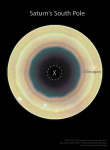 APOD: 2026 September 8 Б Hubble: Decagon Around Saturns South Pole
7.09.2026
Why are SaturnБs poles geometric? SaturnБs North Pole has been known to be surrounded by a hexagonal (6 sides) cloud since discovery in 1987 in data taken by NASAБs Voyager spacecrafts, which quickly flew past the ringed world in the early 1980s.
 APOD: 2020 July 26 Б A Flight through the Hubble Ultra Deep Field
25.07.2020
What would it look like to fly through the distant universe? To find out, a team of astronomers estimated the relative distances to over 5,000 galaxies in one of the most distant fields of galaxies ever imaged: the Hubble Ultra Deep Field (HUDF).
 APOD: 2023 September 9 Б Comet Nishimura Grows
8.09.2023
Comet Nishimura is growing. More precisely, the tails C/2023 P1 (Nishimura) are growing as it nears the Sun. Discovered only last month, the comet is already near naked eye brightness as it now moves inside the Earth's orbit.
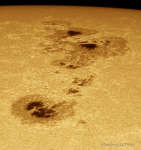 APOD: 2026 June 28 Б AR 4478: Giant Sunspot Group
27.06.2026
Right now, one of the largest sunspot groups in recent history is crossing the Sun. Active Region 4478 is not only big -- it's violent, showing tangled magnetic fields capable of throwing off huge clouds of particles into the Solar System. Some of these CMEs might impact the Earth.
 APOD: 2024 February 12 Б HFG1 & Abell 6: Planetary Nebulae
11.02.2024
Planetary nebulae like Heckathorn-Fesen-Gull 1 (HFG1) and Abell 6 in the constellation Cassiopeia are remnants from the last phase of a medium sized star like our Sun. In spite of their shapes, planetary nebulae have nothing in common with actual planets.
 APOD: 2024 July 2 Б NGC 602: Oyster Star Cluster
1.07.2024
The clouds may look like an oyster, and the stars like pearls, but look beyond. Near the outskirts of the Small Magellanic Cloud, a satellite galaxy some 200 thousand light-years distant, lies this 5 million year old star cluster NGC 602.
 APOD: 2023 April 11 Б North Star: Polaris and Surrounding Dust
10.04.2023
Why is Polaris called the North Star? First, Polaris is the nearest bright star toward the north spin axis of the Earth. Therefore, as the Earth turns, stars appear to revolve around Polaris, but Polaris itself always stays in the same northerly direction -- making it the North Star.
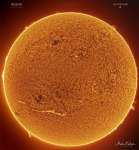 APOD: 2023 February 22 Б Our Increasingly Active Sun
21.02.2023
Our Sun is becoming a busy place. Only two years ago, the Sun was emerging from a solar minimum so quiet that months would go by without even a single sunspot. In contrast, already...
|
January February March April May June July August September |
|||||||||||||||||||||||||||||||||||||||||||||||||