
|
You entered: apod
 APOD: 2023 November 8 Б Perseus Galaxy Cluster from Euclid
8.11.2023
There's a new space telescope in the sky: Euclid. Equipped with two large panoramic cameras, Euclid captures light from the visible to the near-infrared. It took five hours of observing for Euclid...
 APOD: 2024 May 28 Б Solar X Flare as Famous Active Region Returns
28.05.2024
It's back. The famous active region on the Sun that created auroras visible around the Earth earlier this month has survived its rotation around the far side of the Sun -- and returned. Yesterday...
 APOD: 2025 January 14 Б North Star: Polaris and Surrounding Dust
14.01.2025
Why is Polaris called the North Star? First, Polaris is the nearest bright star toward the north spin axis of the Earth. Therefore, as the Earth turns, stars appear to revolve around Polaris, but Polaris itself always stays in the same northerly direction -- making it the North Star.
 APOD: 2023 October 1 Б A Desert Eclipse
1.10.2023
A good place to see a ring-of-fire eclipse, it seemed, would be from a desert. In a desert, there should be relatively few obscuring clouds and trees. Therefore late December of 2019, a group...
 APOD: 2025 June 9 Б Between Scylla and Charybdis: A Double Cosmic Discovery
9.06.2025
Can you identify this celestial object? Likely not Б because this is a discovery image. Massive stars forge heavy elements in their cores and, after a few million years, end their lives in powerful supernova explosions. These remnants cool relatively quickly and fade, making them difficult to detect.
 APOD: 2025 September 11 Б The Umbra of Earth
11.09.2025
The dark, inner shadow of planet Earth is called the umbra. Shaped like a cone extending into space, it has a circular cross section most easily seen during a lunar eclipse.
 APOD: 2025 October 1 Б NGC 6960: The Witchs Broom Nebula
1.10.2025
Ten thousand years ago, before the dawn of recorded human history, a new light would suddenly have appeared in the night sky and faded after a few weeks. Today we know this light was from a supernova, or exploding star, and record the expanding debris cloud as the Veil Nebula, a supernova remnant.
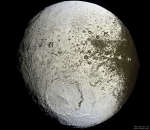 APOD: 2026 July 5 Б Saturns Iapetus: Painted Moon
5.07.2026
What has happened to Saturn's moon Iapetus? Vast sections of this strange world are dark as coal, while others are as bright as snow. To help better understand this unusually tinted moon, in 2007 NASA directed the robotic Cassini spacecraft then orbiting Saturn to swoop within 2,000 kilometers.
 APOD: 2023 October 11 Б NGC 1097: Spiral Galaxy with Supernova
11.10.2023
What's happening in the lower arm of this spiral galaxy? A supernova. Last month, supernova SN 2023rve was discovered with UAE's Al-Khatim Observatory and later found to be consistent with the death explosion of a massive star, possibly leaving behind a black hole.
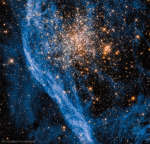 APOD: 2023 February 20 Б NGC 1850: Not Found in the Milky Way
20.02.2023
There is nothing like this ball of stars in our Milky Way Galaxy. This is surprising because, at first glance, this featured image by the Hubble Space Telescope suggests that star cluster NGC 1850...
|
January February March April May June July August September |
|||||||||||||||||||||||||||||||||||||||||||||||||