
|
You entered: magnetic field
29.07.2026
Solar System bodies make deep space exploration more fuel efficient! TodayБs video shows the Psyche spacecraft gaining speed and changing its trajectory with minimal fuel spent due to a gravity assist from Mars in May 2026. Mars has an average orbital speed of almost 87,000 km/h (54,000 mph) around the Sun.
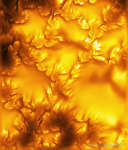 APOD: 2026 August 6 Б New Sharpest Image of the Sun Uncovers Instability
6.08.2026
What does the new sharpest image of our Sun show? Instability. To be clear, a certain kind of interactive process called the Kelvin-Helmholtz instability (KHI). This instability can create waves and swirls when two streams flow past each other -- in this case variable streams of solar magnetic plasma.
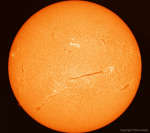 An Extremely Long Filament on the Sun
9.02.2015
Yesterday, the Sun exhibited one of the longest filaments ever recorded. It may still be there today. Visible as the dark streak just below the center in the featured image, the enormous filament extended across the face of the Sun a distance even longer than the Sun's radius -- over 700,000 kilometers.
 APOD: 2026 August 5 Б Spokes on Saturn's B Ring
5.08.2026
DonБt get spooked by SaturnБs ghostly spokes! Today we feature a nearly two-hour timelapse of Saturn and its rings looping forwards and backwards. A day on Saturn is only 10 hours long, so two hours of observation covers quite a bit of its rotation.
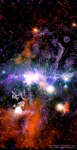 The Galactic Center in Stars, Gas, and Magnetism
2.06.2021
What's going on near the center of our galaxy? To help find out, a newly detailed panorama has been composed that explores regions just above and below the galactic plane in radio and X-ray light.
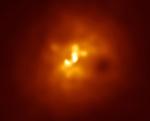 Abell 2597 s Cosmic Cavities
16.01.2002
Typical of large galaxy clusters billions of light-years away, Abell 2597 features hundreds of galaxies embedded in a cloud of multimillion degree gas which glows in x-rays. This Chandra Observatory x-ray image shows...
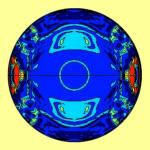 Solar Neutrino Astronomy
17.05.2001
Neutrinos are subatomic particles generated by the nuclear reactions which power stars like our Sun. Flying outward from the Sun's core, they easily pass through the Sun (and almost anything else!) unimpeded and should be detectable by earth-based neutrino "telescopes".
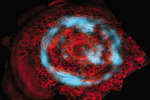 Unusual Auroras Over Saturns North Pole
19.11.2008
What's causing this unusual aurora over Saturn? No one is sure. Infrared images by the robotic Cassini spacecraft of the north pole of Saturn have uncovered aurora unlike any other seen previously in our Solar System.
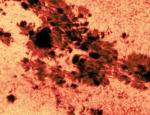 Sunspots: Magnetic Depressions
22.03.1998
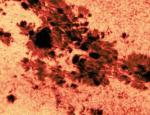
Our Sun has spots! These spots appear dark in photographs like the one above, but in fact sunspots are quite bright - they are just dark compared to the rest of the Sun. Sunspots are about the size of the Earth and frequently occur in groups, as shown above.
 Sunspots: Magnetic Depressions
13.01.1997
Our Sun has spots! These spots appear dark in photographs like the one above, but in fact sunspots are quite bright - they are just dark compared to the rest of the Sun. Sunspots are about the size of the Earth and frequently occur in groups, as shown above.
|
January February March April May June July August September October |
|||||||||||||||||||||||||||||||||||||||||||||||||