
|
APOD: 2026 August 6 Б New Sharpest Image of the Sun Uncovers Instability
Explanation:
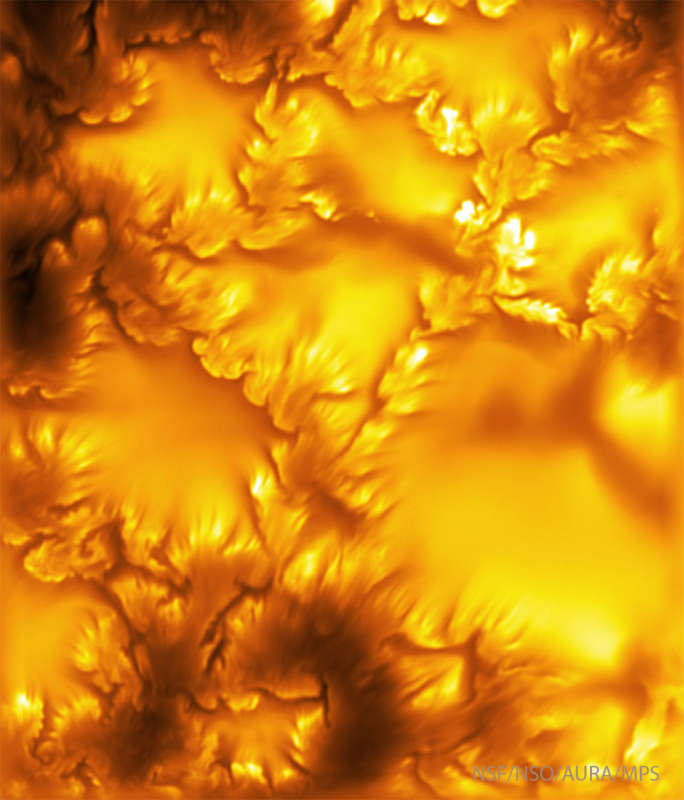
What does the new sharpest image of our Sun show?
Instability.
To be clear, a certain kind of interactive process called the
Kelvin-Helmholtz instability (KHI).
This instability can create
waves and swirls when two streams flow past each other --
in this case variable streams of
solar magnetic plasma.
Long hypothesized to occur on the
Sun's surface,
KHI streaks and swirls were confirmed in
just-released dramatic high-resolution
images taken recently by the
Inouye Solar
Telescope in
Hawaii,
USA.б
The
featured false-yellow image, actually taken in deep blue,
is the highest resolution image yet of
the Sun in
visible light.
It spans about the radius of
the Earth, but its finest details are city sized.
Visible are several smooth tops of
changing solar granules, while the edges of the flower-like
structures have been found to harbor multiple
KHI swirls.
Future research may investigate how the KHI helps move energy,
magnetic fields, and may even heat the surrounding
solar corona.
| << Yesterday | 6.08.2026 | Tomorrow >> |

|
January February March April May June July August September October |
| |||||||||||||||||||||||||||||||||||||||||||||||||||||||
NASA Web Site Statements, Warnings, and Disclaimers
NASA Official: Jay Norris. Specific rights apply.
A service of: LHEA at NASA / GSFC
& Michigan Tech. U.
Based on Astronomy Picture
Of the Day
Publications with keywords: Sun
Publications with words: Sun
See also:
- APOD: 2026 August 9 Б Contemplating the Sun
- APOD: 2026 February 11 Б A Year of Sunspots
- APOD: 2026 February 8 Б Active Sunspot Region 4366 Crosses the Sun
- APOD: 2025 December 7 Б The Sun and Its Missing Colors
- APOD: 2025 May 21 Б International Space Station Crosses the Sun
- APOD: 2025 March 16 Б Venus and the Triply Ultraviolet Sun
- APOD: 2024 September 2 Б A Triangular Prominence Hovers Over the Sun