
|
You entered: loops
 Rocket Engine Fireplace
7.12.2024
You might not think a close up view of rocket engines producing 8.8 million pounds of thrust would be relaxing, but here it can be. In fact, you can get a warm and cozy feeling just spending a few moments watching NASA's holiday rocket engine fireplace.
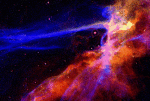 Rampaging Fronts of the Veil Nebula
7.03.1996
A supernova explosion of a high-mass star results in fast moving blast waves. At the front of the waves shown above, ionized gas in the Veil Supernova Remnant rushes out from the explosion, sweeps up material, and breaks up many atoms into constituent ions and electrons.
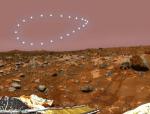 Martian Analemma
30.12.2006
On planet Earth, an analemma is the figure-8 loop you get when you mark the position of the Sun at the same time each day throughout the year. But similarly marking the position...
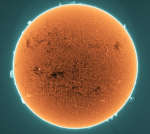 Prominences and Filaments on the Active Sun
15.06.2024
This colorized and sharpened image of the Sun is composed of frames recording emission from hydrogen atoms in the solar chromosphere on May 15. Approaching the maximum of solar cycle 25, a multitude of active regions and twisting, snake-like solar filaments are seen to sprawl across the surface of the active Sun.
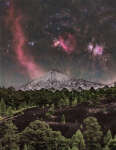 APOD: 2026 May 5 Б Orion over Mount Teide
5.05.2026
Orion is rarely seen like this. To achieve this majestic vista, you need a camera capable of taking such long duration exposures that faint features in the night sky become revealed. Iconic nebulas that appear include the Orion Nebula, the Flame Nebula, and Barnard's Loop.
 APOD: 2024 April 22 Б Moon and Smoke Rings from Mt Etna
22.04.2024
Yes, but can your volcano do this? To the surprise of some, Mt. Etna emits, on occasion, smoke rings. Technically known as vortex rings, the walls of the volcano slightly slow the outside of emitted smoke puffs, causing the inside gas to move faster.
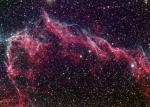 NGC 6992: A Glimpse of the Veil
28.09.2001
After 5,000 years, the gorgeous Veil Nebula is still turning heads. Cataloged as NGC 6992, these glowing filaments of interstellar shocked gas are part of a larger spherical supernova remnant known as the Cygnus Loop or the Veil Nebula -- expanding debris from a star which exploded over 5,000 years ago.
 Point Reyes Milky Way
12.03.2022
Northern winter constellations and a long arc of the Milky Way are setting in this night skyscape looking toward the Pacific Ocean from Point Reyes on planet Earth's California coast. Sirius, alpha star of Canis Major, is prominent below the starry arc toward the left.
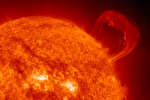 A Solar Prominence from SOHO
31.05.2009
How can gas float above the Sun? Twisted magnetic fields arching from the solar surface can trap ionized gas, suspending it in huge looping structures. These majestic plasma arches are seen as prominences above the solar limb.
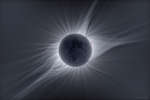 The Big Corona
20.09.2017
Most photographs don't adequately portray the magnificence of the Sun's corona. Seeing the corona first-hand during a total solar eclipse is unparalleled. The human eye can adapt to see coronal features and extent that average cameras usually cannot. Welcome, however, to the digital age.
|
January February March April May June July August September |
|||||||||||||||||||||||||||||||||||||||||||||||||